

A scissor lift table is used to raise, lower and position heavy loads at a convenient working height, while mobile versions also allow goods to be transported. Discover how scissor lift tables improve material handling in warehouses, workshops and factories, and how to choose the right load capacity, lifting range, platform size and drive system.
A scissor lift table is designed to raise, lower and, in its mobile configuration, move heavy loads. It positions materials, containers, machine parts and equipment at a convenient height for the operator. It is therefore commonly used in warehouses, workshops, manufacturing facilities, logistics and assembly operations.
Depending on its construction, it can operate as a transport trolley with a lifting platform, a height-adjustable workstation or a stationary lifting device. It reduces manual lifting, repeated bending and unnecessary handling between workstations.
A scissor lift table does not replace a forklift truck or equipment designed for high-level storage. Its primary purpose is load positioning and height adjustment between different working levels, such as the floor, a workbench, shelf, machine, loading bay or conveyor. Horizontal movement is only intended for models specifically designed for transport.
How does a scissor lift table work?
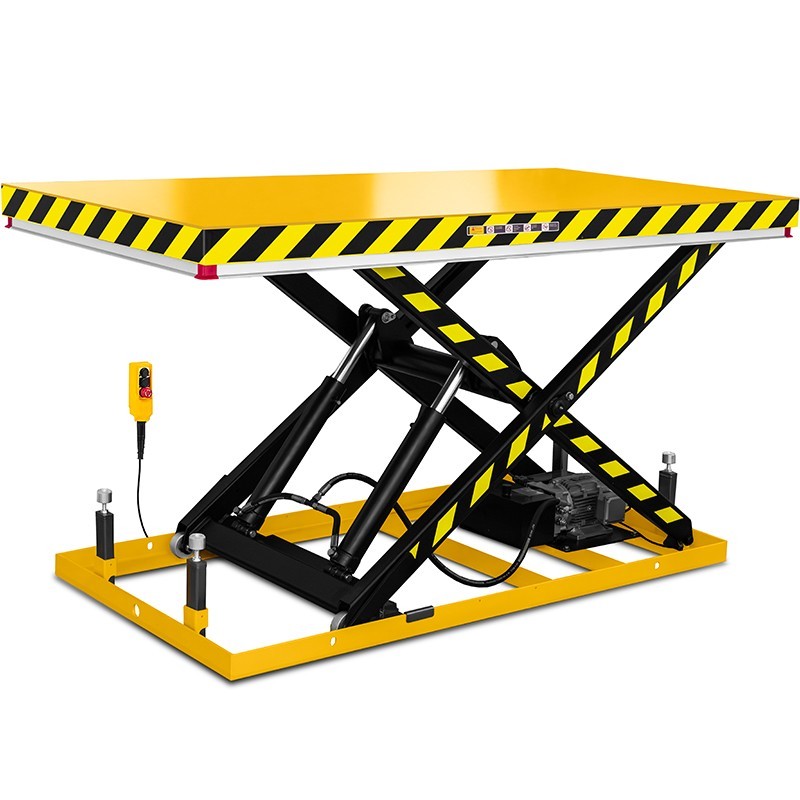
Beneath the platform is a mechanism consisting of crossed arms resembling scissors. As the arms extend, the platform rises; as they fold, it lowers. This arrangement allows height adjustment within the operating range specified by the manufacturer.
On manual hydraulic models, the operator activates a pump using a foot pedal. Repeated presses gradually raise the platform, while a dedicated control mechanism allows it to descend in a controlled manner. No electrical power supply is required.
In electrohydraulic versions, the pump is driven by a motor, reducing physical effort when frequent lifting cycles are required. Power can come from the mains or, on suitable mobile models, from a rechargeable battery.
Mobile scissor lift trolleys feature wheels, a push handle and brakes. Stationary tables are installed alongside production lines, assembly stations or loading and transfer points. The instructions for the specific model must always be followed.
Scissor lift table applications in warehouses
In a warehouse, a scissor lift table makes it easier to handle parcels, containers, components, tools and consumables. Suitable CORMAK scissor lift platform trolleys can support the movement of goods between receiving, picking, packing and dispatch areas.
The platform height can be matched to shelving, workbenches or conveyors. Instead of lifting a container manually from the floor, the operator raises it mechanically and transfers it to an adjacent surface, provided the table's construction and transfer method allow this to be done safely.
During order picking, containers can be positioned at a comfortable level, such as around waist height. This reduces repeated bending. At packing stations, finished components can be placed on a bench, secured and moved to dispatch without additional manual lifting.
For small palletised loads, platform dimensions, loading arrangements and permitted load distribution must also be checked. Not every lift table is suitable for every pallet, particularly where the load overhangs the platform or its weight is concentrated in a small area.
Scissor lift tables in production and assembly
In manufacturing facilities, a scissor lift table can act as a height-adjustable workstation. It can support assemblies, moulds, machine components, containers of parts and workpieces awaiting quality inspection.
Adjusting the platform height makes fastening, assembly, drilling, packaging and inspection easier, provided the equipment is suitable for the forces and loads involved. Changing the working height during the process can reduce the need to move components between stations.
When servicing machine tools, a lift table can assist with feeding materials, collecting finished parts and changing fixtures. Once the working levels have been aligned, items can be transferred using appropriate guides, guards or additional handling equipment.
One example is the CORMAK TA3510 scissor lift trolley with a 350 kg load capacity and a maximum lifting height of 1300 mm. However, platform size, lifting range, capacity and load support must be matched to the machine so that overhanging components do not create a hazard.
Mobile or stationary scissor lift table?
A mobile scissor lift table combines load lifting with transport between workstations. It is particularly useful in warehouses, service departments and workshops with changing workflows. An example is the CORMAK TA50 hydraulic scissor lift trolley, offering a 500 kg capacity and a lifting range of 340–900 mm.
Wheel diameter and material are important selection factors. Small wheels have more difficulty crossing thresholds and uneven surfaces, while larger wheels can affect the platform's minimum height. Brakes must hold the equipment securely during loading, unloading and lifting.
A stationary scissor lift table operates in a fixed location, such as beside a roller conveyor, loading bay or assembly line. These units are available with different platform dimensions and lifting capacities. Compare CORMAK stationary scissor lift tables according to the required lifting height, installation conditions and anticipated load.
| Type | Typical task | Important considerations |
|---|---|---|
| Mobile | Transport between workstations and height adjustment | Wheels, brakes, floor conditions and stability |
| Stationary | Lifting at fixed workstations or production lines | Installation location, power supply and protection of the working area |
How do you choose the correct load capacity?
Load capacity must be selected according to the maximum weight of the complete assembly being lifted. This includes the workpiece, container, pallet, brackets and any additional equipment. Operating continuously at the rated capacity limit is not recommended.
For example, if a component weighs 400 kg, a table rated at 400 kg leaves no allowance for packaging or attachments. A higher capacity should be selected based on actual operating conditions rather than the weight of the component alone.
The position of the centre of gravity is equally important. Rated capacity normally assumes a specified load distribution. Weight concentrated near the platform edge can place different stresses on the structure and compromise stability.
Before operation, check the manufacturer's documentation for permitted loading, weight distribution and any restrictions concerning asymmetrical loads. A high nominal capacity does not automatically mean that every object can be lifted safely.
Lifting range and platform dimensions
The minimum platform height determines how far a load can be lowered. This matters when loading, collecting items from floor level and positioning the platform beneath materials where the construction allows this.
The maximum lifting height must correspond to the levels of machines, workbenches, shelving and conveyors. Before purchasing, measure every workstation involved, including the thickness of pallets, containers and supporting components.
The platform must support the load securely in accordance with the manufacturer's requirements. A platform that is too small may create dangerous overhangs, while one that is too large can make manoeuvring through narrow aisles difficult. Adequate operating space must also be provided.
Begin by measuring the lowest and highest required working positions, the dimensions of the largest load and the widths of access routes. These figures can then be compared with the technical specifications of the proposed model.
Manual or electric operation?
A manual hydraulic lift table is suitable for occasional use and relatively few lifting cycles. It has straightforward controls, does not require battery charging and, if mobile, can be used in different areas of a facility.
An electric model makes frequent lifting and height adjustment easier. For example, the battery-powered CORMAK TAE50 scissor lift trolley has a 500 kg load capacity and a platform height range of 280–900 mm. The electric lifting system eliminates manual pumping.
Battery-powered equipment requires monitoring of battery condition and safe charging procedures. Mains-powered tables need an appropriate electrical installation and protection against cable damage.
When selecting a model, compare load weights, the number of working cycles, the frequency of height adjustment and the organisation of work. Electric operation improves convenience, but does not remove load limits or safety requirements.
Safe operation of a scissor lift table
Loads should be positioned securely, as centrally as possible, and protected against sliding. Never exceed the rated capacity or use the table for purposes not permitted by the manufacturer.
Before lifting or transporting, inspect the wheels, brakes, platform, scissor mechanism and visible hydraulic components. Mobile tables must be immobilised according to the operating instructions during loading and unloading.
Movement should take place on level floors with sufficient load-bearing strength. Avoid sudden turns with the load raised high, because the elevated centre of gravity increases the risk of overturning. Transport loads at the height recommended by the manufacturer.
- Keep hands and feet away from crushing points around the scissor arms and underneath the platform.
- Before maintenance, engage the specified maintenance safety supports and isolate the relevant energy sources.
- Never lift people: an ordinary goods lift table is not a personnel working platform.
- Follow the operating manual, equipment markings and required technical inspections.
If the table is integrated into machinery or a production line, additional hazards associated with platform movement, crushing points and load transfer must be assessed. Appropriate safeguards depend on the application and technical documentation.
Summary
A scissor lift table makes lifting, lowering and, where appropriate, transporting materials easier in warehousing, manufacturing, assembly and maintenance. Its main advantage is the ability to position a load at a height suited to the task.
Mobile models support material movement between workstations, while stationary tables can be integrated with industrial production lines. Key selection criteria include load capacity, weight distribution, lifting range, platform dimensions, drive system and floor conditions.
A correctly selected lift table improves workplace ergonomics and reduces manual handling. Before purchasing, compare the specifications of CORMAK models with the actual process, frequency of use and applicable safety requirements.
