


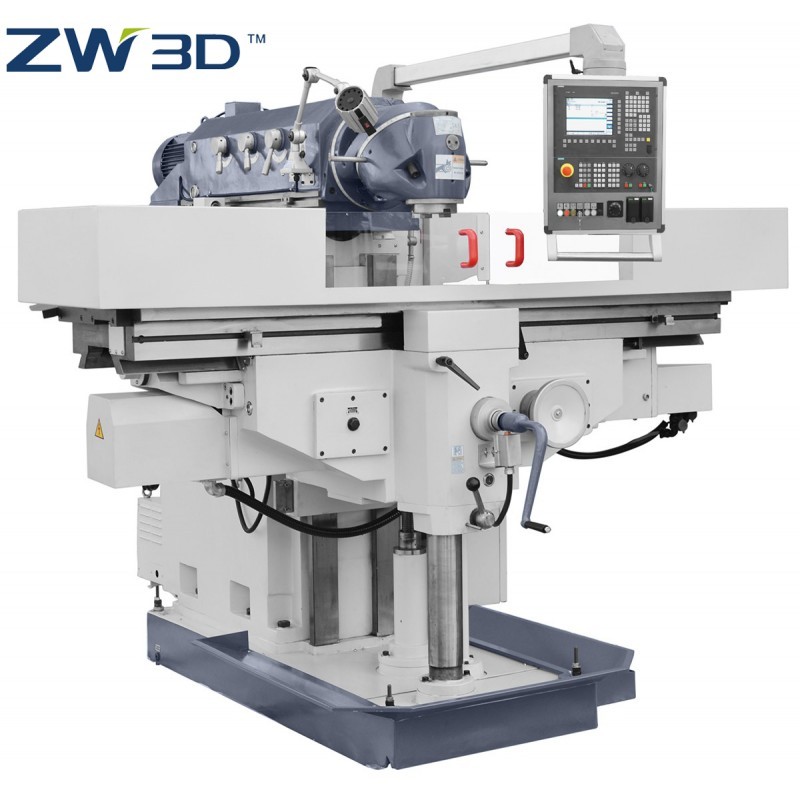
The choice between a conventional milling machine and a CNC milling machine depends on the workshop’s workload, budget, number of orders and the required precision. One type of machine is best suited to one-off repairs and making spare parts, whilst another is better for the mass production of parts with consistent dimensions.
The choice between a conventional milling machine and a CNC milling machine depends on the workshop’s workload, budget, number of jobs and the required precision. One type of machine is better suited to one-off repairs and making spare parts, whilst another is better for the mass production of parts with consistent dimensions.
Both a classic metal milling machine and a modern CNC centre can deliver excellent results. However, it is essential to match the machine to the workshop’s actual needs: the type of material, the size of the workpieces, tolerances, frequency of operation and the operators’ skills.
Conventional and CNC milling machines – the key difference
A conventional milling machine is manually operated. The operator sets the table position, selects the feed rate, cutting depth and spindle speed, and monitors the machining process. The result therefore depends largely on the operator’s experience, the machine’s rigidity, the quality of the tool and the correct clamping of the workpiece.
A CNC milling machine operates according to a pre-programmed sequence. Once the workpiece is clamped, the tools are set and the parameters are entered, the machine performs the planned movements automatically. This makes it easier to achieve high accuracy, dimensional repeatability and consistent quality when producing multiple identical components.
When is it worth choosing a conventional milling machine?
A conventional milling machine is particularly well-suited to workshops that produce individual workpieces, carry out repairs, modifications and manufacture simple structural components. It is a good choice for metalworking shops, maintenance departments, tool rooms and companies that frequently undertake non-standard tasks.
Its great advantage is its flexibility. The operator can quickly clamp the workpiece, set the parameters and start work without having to programme the machine. For simple grooving, face milling, undercutting, chamfering or machining a single part, such a machine can often be quicker to set up than a CNC machine.
A universal milling machine is a good solution for many workshops. It allows a wide range of operations to be carried out, such as milling flat surfaces, grooves, edges, holes or simple angled surfaces. This type of metal milling machine is also easier to set up and is usually cheaper to buy.
When is a CNC milling machine the better choice?
A CNC milling machine is preferable where batch production, repeatability and machining accuracy are key. If a company produces many identical parts, components with complex geometries or parts requiring tight tolerances, CNC control offers significantly greater capabilities.
A CNC machine can machine pockets, contours, holes, 3D surfaces, moulds, dies and complex machine components. Once a programme has been prepared, it can be run repeatedly, meaning that subsequent parts are produced more quickly and with a lower risk of operator error.
CNC also allows for better control of cutting parameters. Appropriately selected rotational speed, feed rate, cutting depth and tool path all influence the tool’s service life, dimensional accuracy and surface quality. With a well-prepared process, the number of reworks can be reduced and greater production stability achieved.
Purchase and running costs
A conventional milling machine is usually cheaper to set up initially. It does not require CAM software, advanced programming or extensive training in the use of CNC controls. Servicing, spare parts and basic tools are also often less expensive.
The downside is greater reliance on the operator. In batch production, each component requires more human intervention, which can extend production times and increase the risk of variations between successive parts.
A CNC milling machine requires a greater investment. You need to factor in the purchase of the machine, fixtures, chucks, tools, measuring probes, software and staff training. In return, the workshop gains automation, repeatability, shorter unit times for production runs and the ability to take on more demanding jobs.
Precision, repeatability and operator skill
With a conventional milling machine, the operator’s experience is of great importance. It is the operator who determines the sequence of operations, table positioning, dimensional checks and how the tool is guided. In the hands of an experienced professional, a conventional machine can be highly effective, particularly for one-off jobs.
With CNC machines, part of the responsibility shifts to the preparation of the machining process. What matters is a correct programme, proper workpiece clamping, tool selection and inspection of the first piece. Once the process has been set up, however, the machine can produce subsequent parts with a high degree of repeatability, which is more difficult to achieve with manual machining.
What should you look out for before buying?
Before purchasing, it is worth analysing not only the price of the machine, but also the type of materials to be machined, the maximum workpiece dimensions, the required tolerances, the available space in the workshop and the qualifications of the staff. The availability of after-sales service, spare parts, chucks and cutting tools is also important.
A good machine should be suited to current orders, whilst also leaving some scope for the company’s future growth. If the workshop plans to move into mass production, precision components or more complex parts, it is worth considering a CNC machine at an earlier stage, rather than buying another machine solely for simple tasks.
Is it worth having both solutions?
In practice, many workshops use both types of machine. A conventional milling machine handles quick adjustments, prototypes, the production of individual parts and auxiliary tasks. A CNC milling machine handles production runs, repeatable parts and more demanding components.
This combination offers great flexibility. The operator does not need to tie up the CNC centre with a simple adjustment, whilst mass production can take place on a machine that ensures greater repeatability and shorter cycle times.
What should you choose for a small workshop?
If the workshop mainly carries out repairs, produces individual components, performs simple metalwork and handles short-run jobs, a conventional milling machine will be a sensible choice. It is cheaper, simpler and allows you to respond quickly to various customer needs.
However, if the company wishes to expand production, increase productivity, manufacture repeatable components and move into more precise machining, a CNC milling machine would be the better option. This is an investment in growth, particularly when the volume of orders allows the machine’s full potential to be utilised.
Summary
A conventional milling machine is suitable for one-off production, repairs, simple components and flexible workshop work. A CNC milling machine is better suited to batch production, complex parts and tasks where high accuracy and repeatability are crucial.
The best choice depends on what the workshop does on a day-to-day basis. For a lower budget, quick fixes and one-off jobs, a conventional or universal milling machine is the way to go. For efficient production, precision parts and the development of services, a CNC milling machine is the better option.
