


Compressed air is the primary working medium in workshops, paint shops, production facilities and service centres. It powers pneumatic tools, actuators, valves, sandblasters and a wide range of automation equipment. For the system to operate reliably, not only is the correct pressure required, but also the right air quality.
Compressed air is the primary working medium in workshops, paint shops, production facilities and service centres. It powers pneumatic tools, actuators, valves, sandblasters and a wide range of automation equipment. For the system to operate reliably, not only is the correct pressure required, but also the right air quality.
The most common problem is moisture. The air drawn in by the compressor contains water vapour, which turns into condensate after compression and cooling. Water can accumulate in the tank, pipework, filters and the end-use equipment itself, causing corrosion, reduced performance and malfunctions in the tools.
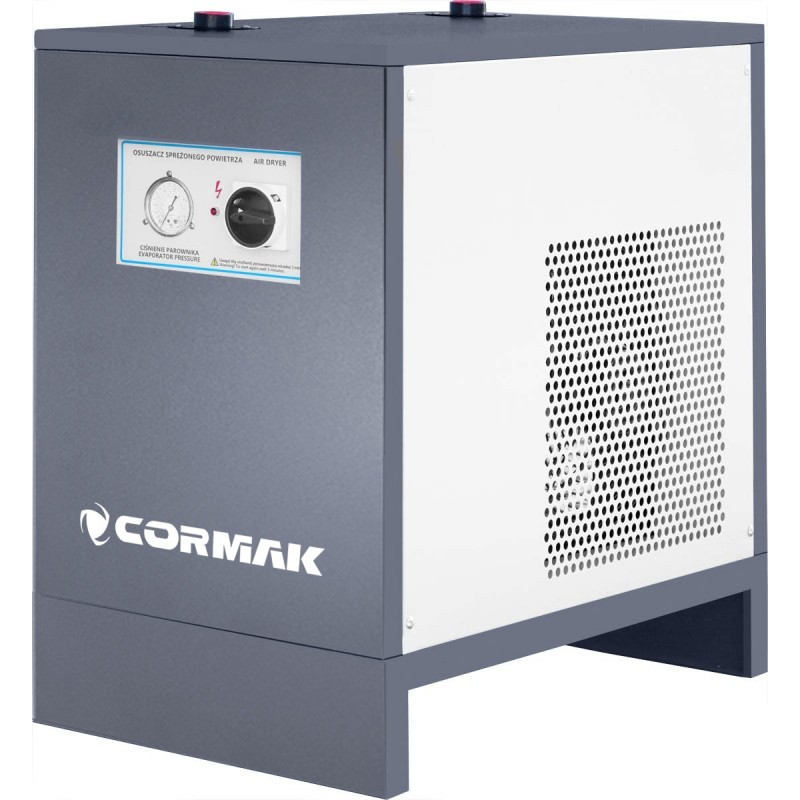
This is precisely why a refrigeration-type air dryer for a compressor is a vital component of the air treatment system. When correctly selected, it reduces the amount of moisture in the system, protects machinery and helps maintain the consistency of the production process. When making a choice, however, it is important to compare several parameters rather than being guided solely by the price of the unit.
Why is moisture in compressed air a problem?
Atmospheric air always contains a certain amount of water vapour. When a compressor increases its pressure, the temperature of the compressed air rises. After leaving the compressor, the air gradually cools down and the excess moisture begins to condense.
Condensate is not always retained in the tank. It can travel along with the air flow and accumulate at the coldest points in the system. Long pipes, incorrectly installed gradients and large temperature differences increase the risk of this happening.
In a pneumatic system, water accelerates the corrosion of metal components. It can wash away lubricants from tools, seals and actuators. Over time, this leads to valves seizing up, erratic operation of end-use equipment and more frequent repairs.
Moisture is particularly dangerous in paint shops. Even a small amount of water can cause blistering, a dull finish or poorer adhesion of the paint. During sandblasting, damp air can impair the flow of abrasive material and hinder the machine’s smooth operation.
When is an air dryer necessary?
It is advisable to install an air dryer when the compressor operates daily or supplies several workstations simultaneously. The greater the compressed air consumption, the more moisture enters the system. Under such conditions, the air receiver, a drain valve and a simple filter alone often do not provide sufficient protection.
The use of a dehumidifier is particularly recommended for spray painting, CNC machining, sandblasting, packaging and work involving automation. This also applies to car workshops and businesses that regularly use grinders, impact wrenches, pneumatic jacks or assembly stations.
A warning sign is a large amount of water draining from the compressor tank. It is also worth taking action if condensate appears on the filters, tools start to rust, or operators notice erratic operation of the equipment. Such symptoms usually indicate that the system requires better air treatment.
Refrigeration dryers are the most common choice for standard industrial applications. They ensure an adequate level of drying in heated halls and workshops, without the need for more expensive adsorption technology.
How does a refrigeration-type dehumidifier work?
A refrigeration-type dehumidifier cools compressed air to separate the moisture it contains. Within the unit, the air flows through a heat exchanger. Its temperature drops, and the water vapour condenses into liquid.
The resulting water is separated in a separator and drained from the system. A refrigerant operating in a closed circuit is responsible for lowering the temperature. The dried air is then fed into the pneumatic system.
Put simply, the refrigeration dehumidifier cools the air, precipitates the water and removes the condensate. Under typical conditions, a refrigeration-type dehumidifier achieves a dew point of around +3°C. This means that moisture should not condense again until the system temperature falls below this value.
This level of dehumidification is sufficient for most workshops and many production processes. However, a refrigeration-type dehumidifier is not designed to produce extremely dry air. For more demanding tasks, adsorption-type dehumidifiers are used.
Refrigeration or adsorption dehumidifier?
The choice depends primarily on the system’s operating environment and the required dew point temperature. A refrigeration-type dehumidifier is the best solution for systems operating indoors where the temperature remains above zero. It is efficient, simple to operate and well suited to the needs of a typical workshop.
An adsorption dehumidifier uses a moisture-absorbing material. This enables it to achieve significantly lower dew point values, such as -20°C or -40°C. This is important in outdoor installations, cold stores and industries requiring very dry air.
Examples include certain processes in the pharmaceutical, electronics or food industries. In a typical workshop, purchasing an adsorption dehumidifier is usually not necessary. It may incur higher energy and maintenance costs without any clear benefit to the process.
How do you select the right capacity for a dehumidifier?
The most important parameter is the dehumidifier’s capacity. This should be compared with the compressor’s effective capacity, i.e. the actual volume of air supplied to the system. Motor power alone is not sufficient, as two compressors with similar power ratings may have different actual flow rates.
The dehumidifier’s capacity should be at least equal to that of the compressor. In many cases, it is worth choosing a unit with some margin, especially if the company plans to expand the system or periodically operates under heavy loads. A dehumidifier that is too small may not remove moisture effectively when several loads are operating simultaneously.
Operating pressure, inlet air temperature and ambient temperature must also be taken into account. In their catalogues, manufacturers often specify capacity for specific conditions, for example at 25°C or 40°C. At higher temperatures, the unit has a more demanding task and its actual capacity may be lower.
The maximum air intake of the connected machines is also a key factor. It is worth adding up the requirements of all loads that may be operating simultaneously. In doing so, you should take into account not only the current machinery but also any planned expansion of the system.
Where should the dehumidifier be installed?
The dehumidifier should be installed downstream of the compressor and the compressed air receiver. It is good practice to fit an aftercooler, a condensate separator and a pre-filter upstream of it. This arrangement protects the unit from excess water, oil and larger particles of contamination.
An additional fine filter can be fitted downstream of the air dryer. In paint shops or at workstations requiring high precision, it is advisable to use a filter suitable for the type of contaminants present. The air dryer removes moisture but does not replace oil and dust filtration.
Proper condensate drainage is essential. It is advisable to regularly check that the drain is working correctly and inspect the condition of the filters. A blocked drain can reduce the efficiency of the entire system, even if the dehumidifier itself has been correctly selected.
The most common mistakes when choosing a dehumidifier
A common mistake is choosing a dryer without sufficient capacity reserve. The problem arises later when the company connects another piece of equipment or increases the number of shifts. A second mistake is ignoring the temperature of the compressed air and the ambient conditions.
It is also not advisable to install a dryer without pre-filters. Oil and solid particles can impair its performance and shorten the system’s service life. It is also important to ensure adequate ventilation, as the unit must be able to dissipate heat effectively.
It is also a mistake to treat a dehumidifier as a substitute for the entire treatment system. In practice, a good system should include a properly selected compressor, receiver tank, drainage, filtration, a dehumidifier and regular servicing.
Summary
A refrigeration-type dehumidifier for a compressor helps to maintain the correct quality of compressed air and reduces the risk of corrosion, breakdowns and manufacturing defects. It works best in heated workshops and factories where a certain level of air drying is required, but there is no need to achieve a very low dew point.
When purchasing, you should compare the compressor’s effective capacity, working pressure, operating temperature and the requirements of the end-use equipment. A well-chosen refrigeration-type dehumidifier, fitted with filters and an efficient condensate drainage system, will protect the compressed air system and help minimise costly downtime in the future.
