


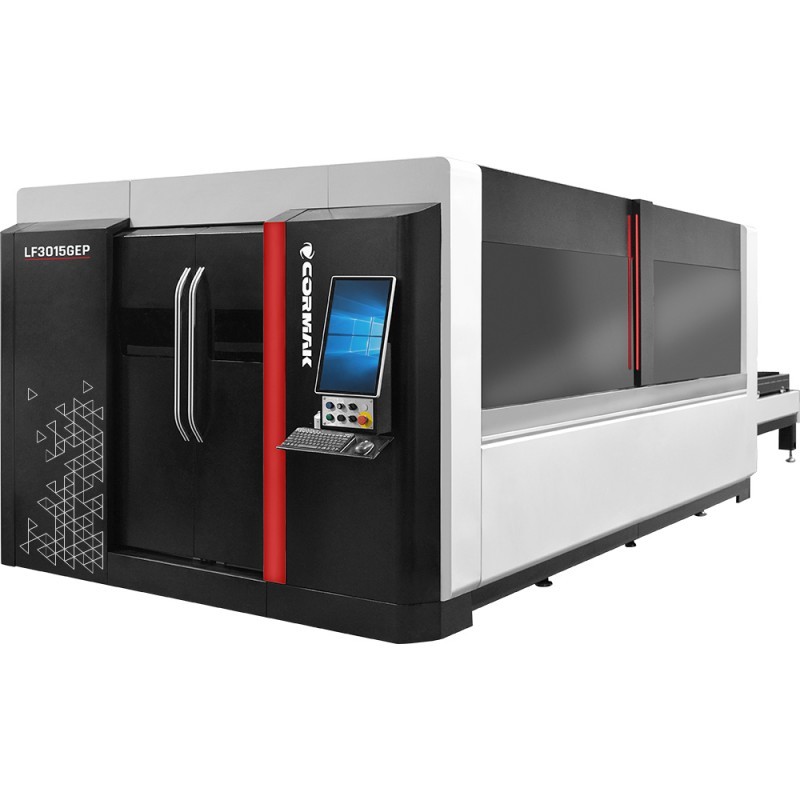
The choice between a laser cutter and a plasma cutter depends primarily on the material, the thickness of the sheet metal, the required tolerances and the extent of post-cutting machining required. Both technologies are widely used in the processing of steel, aluminium and stainless steel, but they have different strengths.
The choice between a laser cutter and a plasma cutter depends primarily on the material, the sheet thickness, the required tolerances and the extent of post-cutting processing required. Both technologies are widely used in the processing of steel, aluminium and stainless steel, but they have different strengths.
Laser cutting offers high accuracy, a narrow kerf and excellent edge quality, particularly with thinner and medium-thickness sheets. CNC plasma, on the other hand, is well-suited to thicker materials, simpler components and applications where productivity and a favourable initial investment cost are key.
Laser and plasma – key differences
A laser cutter uses a concentrated beam of light that locally melts or vaporises the material. Depending on the technology and process gas used, it is possible to achieve a very precise cut, a narrow kerf, good repeatability and an edge that often requires minimal post-cutting machining.
A plasma cutter, also known as a plasma cutting machine, uses a jet of ionised gas at a very high temperature. Plasma cuts through electrically conductive metals rapidly, making it a practical solution for cutting carbon steel, stainless steel, aluminium and structural components of greater thickness.
In practice, a laser is chosen where precision and aesthetics are key, whilst plasma is preferred where material thickness, simpler part shapes and cost-effective production of structural components are paramount.
Criterion 1: material
Mild steel
Mild steel can be processed using both laser and plasma cutting. Laser cutting is suitable for parts requiring high accuracy, small holes, repeatability and clean edges. Plasma cutting is practical for frames, brackets, steel structures, mounting plates and components where a wider dimensional tolerance is acceptable.
Stainless steel
Laser cutting is often the preferred choice for stainless steel, as it produces a more aesthetically pleasing edge and minimises the need for grinding. This is particularly important for enclosures, panels, balustrades, decorative elements and machine parts. Plasma cutting can also be used for stainless steel, but where high visual standards are required, the workpiece may need additional edge finishing.
Aluminium
Aluminium can be cut using both technologies. Fibre laser works well with thin and medium-thickness sheets, where precision, a narrow kerf and high-quality contour are important. Plasma is a good choice for thicker structural components, where the priority is rapid material separation and an acceptable processing cost.
Criterion 2: sheet thickness
For thin sheets, laser cutting usually has the advantage. It enables precise dimensions, sharp contours, small holes and a high-quality cut surface. The workpiece can be sent on to bending, welding, assembly or painting more quickly.
For medium thicknesses, the choice depends on production requirements. If high precision, minimal burr and minimal post-cutting machining are important, laser cutting will be the better option. If the workpiece has a simpler shape and the tolerances are less stringent, a plasma cutter may be more cost-effective.
For thick sheets, plasma cutting is often the practical solution. Plasma cutters are used in the production of steel structures, machine components, frames and panels, where productivity, ease of use and good value for money are key.
Criterion 3: tolerances and edge quality
A laser is the preferred choice when a workpiece must have precise dimensions, a complex contour, small holes, narrow bridges or an aesthetically pleasing edge. Good cut quality can minimise the need for deburring, grinding and the time required to prepare the component for the next stage of production.
Plasma cutting is suitable where tolerances are less stringent and additional edge finishing is acceptable. A well-chosen CNC plasma cutting system with proper torch height control, gas parameters and cutting speed allows for consistent results in many workshop and structural applications.
It is worth bearing in mind that edge quality depends not only on the technology. Other factors that are important include the condition of the material, power source output, choice of nozzles, process gas, cutting speed, piercing, table positioning, extraction and the condition of consumables.
Speed, cost and post-cutting processing
When comparing laser and plasma cutting, it is not enough to look solely at the cutting speed in millimetres per minute. What matters is the total cost of producing the part: programming, piercing, gas consumption, consumables, energy, deburring, grinding, straightening and preparing the part for further processing.
A laser may be more expensive to purchase, but for components requiring high precision, it can reduce the time spent on manual work after cutting. Plasma cutting usually has a lower entry threshold and works well where a large proportion of production involves thicker components with less stringent tolerances.
Therefore, the best choice should be based on actual orders, rather than solely on catalogue specifications. It is worth analysing the materials most frequently cut, their thicknesses, quality requirements and the number of components produced each month.
Laser or plasma – a quick comparison
| Criterion | Laser cutter | Plasma cutter |
|---|---|---|
| Best suited for | Precision parts, thin and medium-gauge sheet metal, complex contours | Thicker sheet metal, steel structures, components with wider tolerances |
| Edge quality | Very good, often requiring less post-cutting machining | Good for many applications, often requires cleaning where higher standards are required |
| Cut gap | Narrow, suitable for small parts and precise contours | Wider, depending on the parameters and material thickness |
| Initial cost | Usually higher | Usually lower |
| Post-cutting machining | Often limited, depending on the part’s requirements | Deburring or edge grinding is more often required |
What should you choose for your production?
Choose a laser if you are cutting thin or medium-gauge sheet metal, and require high precision, small holes, a clean-cut edge and repeatability. This is a good choice for stainless steel, enclosures, panels, parts for bending, and components that need to move quickly on to further processing.
Choose plasma if you are mainly cutting thicker sheets, steel structures, frames, brackets and components with wider tolerances. A plasma cutter is practical for businesses seeking efficient metal cutting at a lower capital cost.
If your production involves a wide variety of materials and thicknesses, it is worth considering testing sample parts. A test on actual material often reveals more than a mere table of specifications.
Summary
A laser cutter ensures high precision, good cut quality and an aesthetically pleasing edge. It is particularly suitable for thin and medium-thickness sheet metal, parts with complex contours and production requiring repeatability.
A plasma cutter is a good choice for thicker materials, steel structures and components where a wider tolerance is acceptable. The choice of the appropriate technology should be based on the material, sheet thickness, tolerances, edge quality and the total cost of producing the part.
