


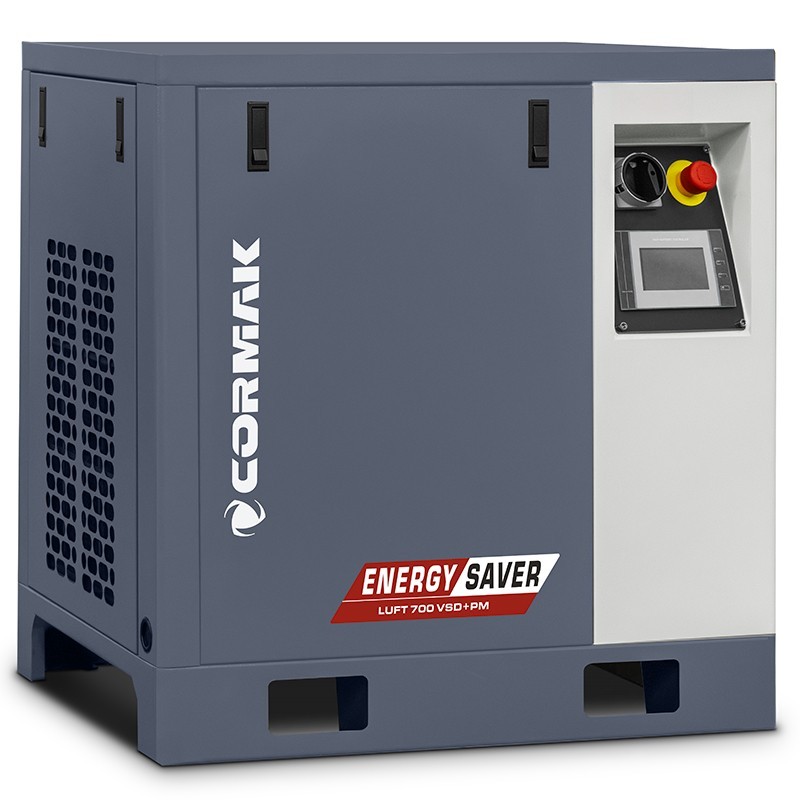
Compressed air is one of the key working media in industry. It powers machinery, production lines and pneumatic tools, which is why the cost of producing it is significant for the entire plant. Screw compressors with PM motors are being used more and more frequently, particularly in systems with variable air demand.
Compressed air is one of the basic working media in industry. It powers machinery, production lines and pneumatic tools, which is why the cost of producing it is important for the entire plant. Screw compressors with PM motors are increasingly being used, particularly in systems with variable air demand.
A PM motor can help reduce energy consumption, but it is not in itself a guarantee of savings. The effect also depends on the screw stage used, inverter control, the actual air consumption profile, working pressure, the tightness of the system and the correct selection of the equipment.
What is a PM motor?
PM stands for Permanent Magnet. In a PM motor, the rotor’s magnetic field is generated by permanent magnets, rather than by currents induced in the rotor cage, as in a typical induction motor. Reducing losses in the rotor can improve the efficiency of the entire drive.
In screw compressors, PM motors are usually combined with an electronic control system. This configuration allows for precise control of the drive’s speed and torque, which is particularly important when operating away from the full-load point.
Not every PM motor has the same design or the same specifications. When comparing units, it is worth analysing the data for the entire compressor, rather than just the motor type listed in the catalogue.
How does a PM motor work in a screw compressor?
In a screw compressor, the motor drives the screw stage. Two rotors rotate relative to one another, and the intake air is gradually confined within working spaces of progressively smaller volume. As a result, the pressure increases, and the compressed air is then fed on to the system, a storage tank, a dehumidifier or a treatment system.
The PM motor is responsible for supplying torque to the screw stage. Depending on the compressor design, the drive may be connected to the screw stage either directly or via a gearbox. If the manufacturer uses a direct drive, some of the mechanical losses associated with an additional transmission can be reduced, but this is not a feature of every PM motor-driven compressor.
In practice, three parameters matter to the user: the air flow delivered at the required pressure, power consumption, and the unit’s ability to operate stably under varying demand.
Where does the potential for energy savings come from?
A PM motor can offer high efficiency across a wide range of operating conditions. This means that a larger proportion of the electrical energy can be used to drive the compressor, whilst less is lost as heat within the motor itself.
However, the most important factor is how the entire system operates. In many factories, compressed air demand fluctuates throughout the day: it varies during line start-up, during breaks, and again when individual tools are in use. A compressor that can reduce its speed rather than running for long periods in idle or throttled mode can better match air production to the current demand.
The potential benefits of a PM drive and speed control include:
- reduced energy losses in the drive;
- better energy utilisation at partial load;
- a reduced risk of prolonged non-productive operation when demand falls;
- more stable maintenance of the set pressure;
- easier adaptation of output to fluctuating consumption patterns.
Savings should not be assessed on the basis of a single parameter or an advertised percentage. They require a comparison of the energy consumption of the entire system under actual operating conditions.
PM motor and inverter – when does this combination make sense?
An inverter, also known as a frequency converter, regulates the motor’s rotational speed. In a screw compressor, this allows the compressor’s capacity to be varied according to the current air demand.
Combining a PM motor with an inverter can be particularly beneficial when:
- the demand for compressed air varies significantly during a shift;
- the installation experiences periodic peaks in demand but does not require full capacity at all times;
- it is important to maintain as stable a pressure as possible;
- the company wishes to minimise prolonged compressor operation at low loads;
- the system has been checked for leaks, pressure losses and correctly sized pipework.
Not every system requires a single variable-speed compressor. In larger compressor rooms, a combination of units is often an effective solution: a single variable-speed compressor covers the variable part of the demand, whilst fixed-speed units handle the stable base load. The selection of such a system should be based on air consumption measurements.
PM motor versus traditional induction motor
| Criterion | PM motor | Induction motor |
|---|---|---|
| Generation of the rotor field | Permanent magnets | Electromagnetic induction in the rotor |
| Losses in the rotor | May be lower | Losses associated with rotor currents occur |
| Variable-speed operation | Often used with a dedicated control system | Possible with an inverter, depending on the motor and application |
| Part-load efficiency | May be advantageous in a suitably selected system | Depends on the design of the motor and the control system |
| Key considerations when purchasing | Overall efficiency of the compressor and compliance with the demand profile | Efficiency of the entire compressor and compatibility with the load profile |
The induction motor remains a tried-and-tested solution in many industrial compressors. The choice between it and a PM motor should be based on an analysis of the entire unit and, above all, on how the compressed air system actually operates.
How to select a screw compressor with a PM motor?
The selection process should begin by identifying the system’s requirements, rather than focusing solely on the motor’s power rating. It is worth collecting data on actual air consumption, the required pressure, the number of consumers, operating time and the air quality required by the process.
1. Measure or estimate the air demand
Take into account the flow rate of all consumers, their simultaneity factor and fluctuations in consumption throughout the day. For larger systems, the most reliable picture is obtained by measuring flow and pressure over a representative operating period.
2. Compare effective performance at the required pressure
Do not compare units solely on the basis of displacement or motor power. Check the capacity delivered at a specific operating pressure and the power consumption at the relevant operating points.
3. Assess the load profile
If the system operates almost continuously at a similar level, a fixed-speed compressor may be the right choice. If the load varies significantly, a PM drive with a variable-frequency drive may make better use of energy – provided it is correctly selected.
4. Check the system, not just the compressor
Leaks, excessively high set pressure, blocked filters, inappropriate pipe diameters and a lack of air treatment can increase costs regardless of the motor type. Even the best compressor cannot compensate for problems in the system.
5. Consider servicing and operating conditions
Check the maintenance schedule, the availability of consumables, ventilation requirements for the compressor room, the noise level specified by the manufacturer, and the options for monitoring the unit’s operation.
Purchase price versus total cost of ownership
A screw compressor with a PM motor and inverter control may have a higher purchase price than a simpler model. When making a decision, it is worth comparing the total cost of ownership, which includes electricity, servicing, consumables, downtime, compressed air quality and expected operating hours.
Cost-effectiveness depends on the number of operating hours, the price of electricity, fluctuations in consumption, and whether the unit is correctly selected. The return on investment should be calculated for a specific installation, based on verifiable measurements and assumptions.
FAQ – frequently asked questions
What does ‘PM’ mean in a compressor motor?
PM stands for Permanent Magnet. In a PM motor, the rotor uses permanent magnets to generate a magnetic field.
Does a screw compressor with a PM motor always use less energy?
Not always. It can be very efficient, particularly when used with an inverter and under variable air demand, but actual energy consumption depends on the compressor as a whole and the installation.
Is a PM motor suitable for continuous operation?
This depends on the design of the specific compressor, its duty cycle and operating conditions. The manufacturer’s technical specifications and recommendations must be followed.
Is a screw compressor better than a piston compressor?
There is no single answer that applies to all applications. Piston compressors often perform well in intermittent operation, whilst screw compressors are commonly used where a stable supply and longer operating times are required.
How do you select the compressor motor power?
Power is determined by the required flow rate, pressure, compression technology and the efficiency of the unit. First, determine the system’s compressed air requirements, then compare complete solutions at the required operating point.
Summary
The PM motor in a screw compressor uses permanent magnets and can reduce drive losses. However, the greatest potential for savings arises when the entire compressor is correctly selected and the speed control matches the actual compressed air consumption profile.
Before purchasing, it is worth assessing the effective capacity, power consumption, operating conditions, system airtightness and air quality requirements. Only this approach allows you to compare the actual running costs and select the solution best suited to your facility.
