


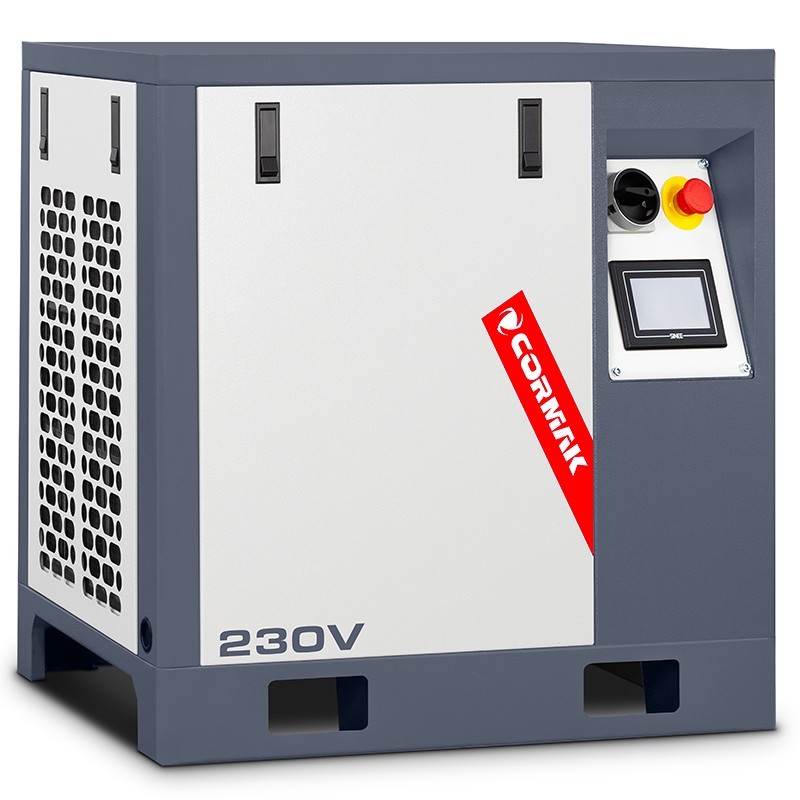
Screw compressors are efficient units for producing compressed air, valued above all for their ability to operate continuously, their high efficiency and their long service life under intensive use. They have been designed to operate even on a 24/7 basis, which is why they are ideal for businesses where compressed air is essential for maintaining process continuity.
Introduction
Screw compressors are efficient devices for producing compressed air, valued primarily for their ability to operate continuously, their high efficiency and their long service life under intensive use. They are designed to operate even on a 24/7 basis, which is why they are ideal for businesses where compressed air is essential for maintaining process continuity.
Their major advantages include stable operating parameters and a design that ensures reliable operation in workshops, paint shops and production facilities. The Polish company CORMAK plays a prominent role in this sector, offering equipment for industry, services and manufacturing. The current product range can be viewed here: CORMAK screw compressors.
Types of screw compressors in the CORMAK range
CORMAK’s range includes screw compressors designed for a variety of applications — from smaller workshops and service centres to production plants operating continuously. Individual models differ not only in power, capacity and range of applications, but also in how the unit is controlled.
From the user’s perspective, the most important distinction is between standard screw compressors and inverter-controlled screw compressors. This distinction makes it easier to match the unit to the nature of the business, the demand for compressed air, and expectations regarding energy efficiency and operational stability.
Standard screw compressors
Standard screw compressors are designed primarily for use in conditions where the demand for compressed air is relatively predictable and consistent. These types of units perform well where the system operates on a fixed schedule and air consumption remains at a similar level for most of the day.
Their advantage lies in a simple and tried-and-tested operating principle, which makes them a popular choice for companies seeking a reliable source of compressed air for everyday workshop, production and service applications.
Within this group, it is worth noting, amongst others, the LUFT series, which is well suited to the needs of small and medium-sized applications, and the THEOR series, designed for more demanding installations. Examples of models include the LUFT 700 and LUFT 1000, whilst models from the THEOR series are also available for higher demand.
Inverter-controlled screw compressors
Inverter-controlled screw compressors are designed to adapt their operation more flexibly to the current demand for compressed air. In practice, this solution is particularly important where the system load is not constant but varies depending on the stage of production, the number of workstations in operation or the nature of the tasks being carried out.
As a result, an inverter-controlled screw compressor can respond more effectively to changing operating conditions and serves as a key benchmark when analysing the energy efficiency of the entire system.
CORMAK also offers inverter-controlled screw compressors, designed for companies wishing to better align the unit’s operation with actual compressed air demand. This solution works particularly well where the system load fluctuates throughout the day, and where smooth operation, operational stability and control of running costs are of great importance.
Examples of such models include the LUFT 1000 with an inverter, the LUFT 1000 VSD+PM and the THEOR 20 with an inverter.
What to look for when choosing a screw compressor
When selecting a screw compressor, it is advisable to base your decision not only on the price of the unit itself, but above all on how intensively it will be used, what air flow rate the system requires, and whether demand at the site is constant or variable.
In the case of CORMAK units, the key factors are, first and foremost, capacity, power, operating pressure and control method, as well as whether a basic model, an inverter version or a COMPACT set with a dehumidifier is required. In practice, one solution will be suitable for a smaller workshop, whilst another will be better suited to a production plant operating on a multi-shift basis.
Unit capacity and power
One of the first parameters worth comparing is the capacity of the screw compressor, as this is what really shows whether the unit can cope with the demand from the workstations.
For smaller applications, the LUFT series models provide a good benchmark; for example, the LUFT 1000 with an inverter, which delivers 7.5 kW and approximately 950–990 l/min. For higher demand, it is worth looking at the THEOR series, for example the THEOR 20 with an inverter, which operates at a capacity of up to approximately 2,000–2,100 l/min, or even larger models in this series.
Constant or variable compressed air demand
If a business operates at a fairly steady pace and air consumption is predictable, a standard screw compressor will often be a sufficient choice. However, if the system’s load varies throughout the day, it is worth considering a model with an inverter, which better adapts the unit’s operation to current demand.
This is precisely why the LUFT and THEOR series are available in both standard and inverter-equipped variants, offering greater flexibility when selecting a unit for a specific operating profile.
Is a dehumidifier required?
When making your choice, it is also worth checking whether your facility needs just a compressor, or a more integrated solution straight away. CORMAK’s range also includes COMPACT versions with an air dryer, which may be a good option where it is important to simplify the installation and have the compressed air prepared directly at the unit itself.
How to choose a model to suit the scale of operations
In practical terms, it can be put this way:
- for smaller workshops and lighter applications, it is worth considering the LUFT series, particularly models in the 650–950 l/min range, such as the LUFT 700 or LUFT 1000;
- for more demanding production and higher air consumption, units from the THEOR series are a better choice, for example the THEOR 20 with an inverter;
- where variable load and greater control over the unit’s operation are important, it is worth considering the version with an inverter;
- where a more comprehensive solution is required, the COMPACT models with a dehumidifier can be considered.
When selecting a CORMAK screw compressor, it is worth starting by answering three key questions: what is the actual demand for compressed air; is the demand constant or variable; and is a compressor alone sufficient, or will a solution incorporating a dehumidifier also be required?
Only then can you make an informed comparison of specific models and their specifications. To facilitate this process, CORMAK’s advisers assist in selecting the equipment and the complete solution, ensuring it is tailored to the specific nature of the work and the needs of the particular site.
It is also worth bearing in mind that throughout the selection, commissioning and subsequent operation phases, CORMAK’s technical and service advisers are on hand to support customers in adapting the solution to actual operating conditions and the requirements of the pneumatic system.
Energy efficiency of screw compressors
In the case of screw compressors, energy efficiency is of great importance, as units of this type often operate for many hours a day and have a significant impact on the running costs of the entire compressed air system.
From the user’s perspective, therefore, it is not only the performance itself that matters, but also whether the unit can adapt its operation to the plant’s actual demand. This is precisely why models with an inverter form such an important group in this category, available in CORMAK’s range in both the LUFT and THEOR series.
The main difference is that a screw compressor with an inverter can smoothly regulate the motor’s rotational speed, thereby better adapting its output to the current demand for compressed air. In practice, this helps to minimise idling, reduce the number of start/stop cycles and cut energy losses resulting from producing more compressed air than the installation actually requires.
CORMAK’s product data sheets also highlight advantages such as stable pressure, ease of use, low noise levels in selected models, and suitability for continuous operation.
This is precisely why the issue of energy efficiency is particularly important wherever the demand for compressed air is not constant throughout the day. If one workstation is running one moment and several machines are running simultaneously the next, a unit without regulation will be more difficult to adapt to such a work pattern.
In models with an inverter, the compressor can respond more flexibly, which helps to maintain operational stability, improve control over running costs and ensure greater predictability of the entire process.
In practice, smaller businesses and workshops may wish to consider models such as the LUFT 1000 with an inverter or the LUFT 1000 VSD+PM, whilst for higher air consumption, it is worth exploring solutions from the THEOR series, such as the THEOR 20 with an inverter.
This overview of the product range demonstrates that CORMAK develops energy-efficient equipment for both smaller applications and more demanding industrial installations.
An additional advantage from the user’s perspective is that, for selected models, CORMAK also provides a user manual in Polish, after-sales service and a 12/24-month warranty, which enhances the peace of mind associated with the purchase and subsequent operation of the unit.
Summary
The choice of a suitable screw compressor should be based primarily on the company’s actual needs, the nature of its operations and its compressed air requirements.
CORMAK’s range includes both standard screw compressors and inverter-controlled screw compressors, making it easier to tailor a solution to the scale of operations and operating conditions.
In practice, factors such as performance, the system’s operating mode, stability of parameters and energy efficiency are particularly important; the latter, in particular, can have a direct impact on a plant’s operating costs when the equipment is used intensively.
Therefore, before selecting a specific model, it is worth analysing the company’s needs and, if in doubt, seeking support from CORMAK’s advisers, who can help you choose the right product and solution for your specific application.
