


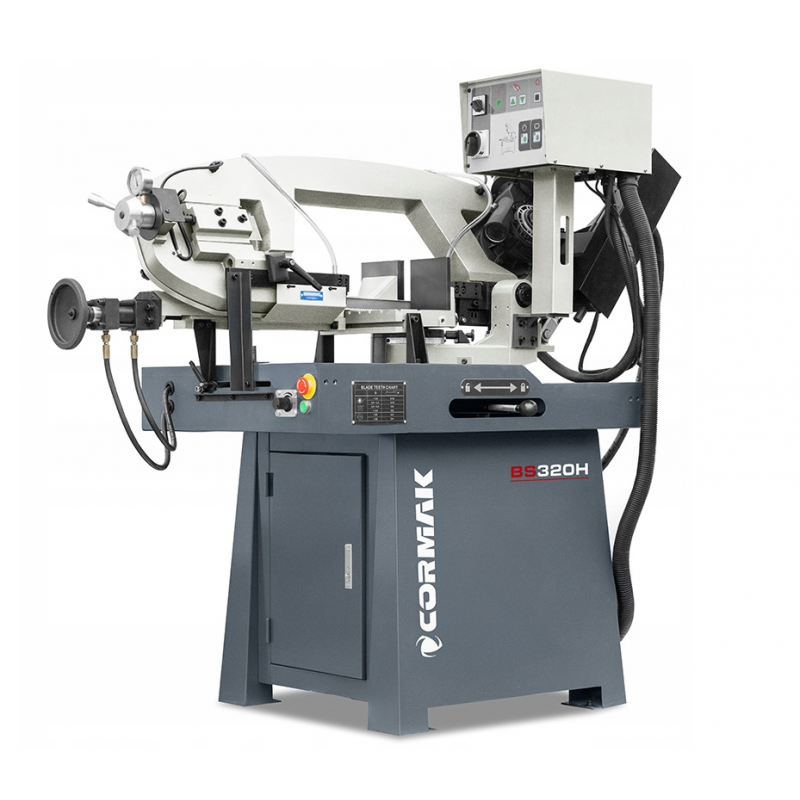
A crooked cut is one of the most common problems encountered when working with a metal band saw. When the machine fails to maintain the correct angle, this results in rework, downtime and material wastage. Cutting accuracy is also compromised, which is particularly important in the production of components for steel structures, frames, profiles and assembly parts.
Why does a band saw cut crookedly? The 8 most common causes
Crooked cuts are one of the most common problems encountered when working with a metal band saw. When the machine fails to maintain the correct angle, this leads to rework, downtime and material wastage. Cutting accuracy also suffers, which is particularly important in the production of components for steel structures, frames, profiles and assembly parts.
A properly adjusted metal band saw should ensure a stable, repeatable and even cut. If the band starts to drift to one side, the cause usually lies in the condition of the saw blade, the machine settings, the choice of parameters or incorrect clamping of the material. Below, we discuss the 8 most common reasons why a band saw cuts crookedly.
1. Worn or damaged cutting band
The most common cause of a crooked cut is a blunt, chipped or unevenly worn blade. Worn teeth do not engage with the material evenly, causing the blade to veer off the cutting line. The problem may be particularly noticeable when the damage is limited to one side of the teeth.
In such a situation, increasing the pressure will not solve the problem. An overly aggressive feed rate may bend the band even further, cause it to overheat and accelerate wear. It is best to stop work, check the condition of the teeth and replace the band if cracks, chipping or one-sided wear are visible.
2. Incorrect choice of band for the material
Not every band is suitable for every material and cross-section. Thin-walled profiles require a different tooth profile to solid shafts, whilst stainless steel, aluminium or difficult-to-machine materials require yet another. A tooth that is too large may tear a thin profile, whilst a tooth that is too fine may become clogged with swarf when cutting solid material.
Incorrectly selected metal band saw blades cause vibration, uneven cutting resistance and the blade to deviate from its correct path. When making a selection, you must take into account the type of material, diameter, wall thickness, cross-section of the workpiece and the machine’s cutting range. A well-chosen band reduces the risk of the cut running off course and improves the quality of the cut surface.
3. Incorrect band tension
The band must operate with the correct tension. If it is too loose, it bends under load, ripples and does not cut in a straight line. It may also slip off the guide wheels or result in an uneven cut surface.
Excessive tension is also undesirable. It can accelerate wear on the bearings, wheels, guides and the band itself. In extreme cases, it can lead to the band breaking, particularly at the welded joint. Tension should be set in accordance with the manufacturer’s instructions for the specific band saw, and checked regularly during intensive use.
4. Incorrectly adjusted or worn guide rails
The guides stabilise the band as close as possible to the cutting point. If they are positioned too far from the workpiece, the unsupported section of the band is longer, and the saw blade is more likely to deviate from the cutting line. A crooked cut may also result from worn rollers, dirty guide rails, play in the guide system or incorrect adjustment.
Before starting work, it is advisable to position the guides as close as possible to the workpiece being cut, leaving only the necessary working clearance. You should also regularly check the condition of the rollers, bearings and guide inserts, as well as the cleanliness of the entire system. A well-maintained band guide system has a direct impact on cutting accuracy.
5. Excessive arm feed rate
Lowering the arm too quickly is a common cause of the band running off track. When the feed rate is too high, the teeth cannot keep up with cutting and chip removal. The band begins to operate under excessive load, bends, overheats and may deviate from the designated line.
The feed rate must be adjusted to suit the material, cross-section and condition of the band. Large solid shafts, thick sections and steel that is more difficult to machine require a gentler cut. A slower, steady feed rate usually results in better quality, extends the service life of the band and reduces the risk of dimensional errors.
6. Unstable material clamping
Even a robust metal-cutting machine will not produce a consistent result if the material shifts in the vice. This problem often arises with long bars, tubes and sections, which sag under their own weight beyond the worktable. During cutting, the workpiece may shift position, which immediately affects the angle and straightness of the cut.
The material should be clamped firmly in the vice and supported stably. Longer workpieces should be guided using rollers, stands or supports. When cutting at an angle, you must also check that the profile does not rotate or shift sideways under the pressure of the blade.
7. Failure to run in a new band
A new band should not be immediately subjected to full feed rate. New teeth are sharp, but their edges require gentle running-in. If they cut too aggressively from the very first cut, they may chip, and the band will quickly lose its uniform cutting geometry.
After fitting a new saw blade, it is advisable to make the first few cuts at a lower feed rate and with a reduced load. Only after a short running-in period should you gradually increase the operating parameters. This is a simple step that helps maintain cutting accuracy and extend the life of the blade.
8. Machine wear or incorrect model selection
A crooked cut may be caused not only by the band but also by the condition of the cutter itself. Play in the arm, worn bearings, misaligned wheels, a damaged vice or a weakened structure all have a significant impact on the quality of the work. In older machines, a lack of rigidity or insufficient motor power in relation to the material being cut can also be a problem.
For intensive use, it is advisable to choose robust metal band saws with a suitable cutting range, a sturdy construction and good band guidance. In mass production, automatic band saws also perform well, as they improve repeatability and minimise the operator’s influence on each cycle.
How can you avoid a crooked cut?
To minimise this problem, you should regularly check the condition of the band, its tension, the guides, the feed rate and how the material is clamped. It is also very important to select the right band for the type of work. Different specifications will be suitable for thin profiles, and others for solid bars, stainless steel or aluminium.
When purchasing a machine, it is worth paying attention to the cutting range, the stability of the arm, the quality of the vice, the ease of adjusting the guides, the availability of consumable parts and the option to connect a cooling system. A well-chosen band saw minimises the need for rework, reduces material waste and helps maintain high-quality workpieces.
Summary
A band saw often cuts crookedly due to a worn or incorrectly selected band, incorrect tension, poorly adjusted guides, excessive feed rate or poor material clamping. The problem does not always indicate a serious machine fault. Often, it is sufficient to replace the band, adjust the settings or reduce the load during cutting.
Regular inspection of the saw, the correct selection of a metal-cutting band saw blade and stable support for the workpiece help to maintain high cutting accuracy, minimise downtime and reduce operating costs in the workshop and in production.
