


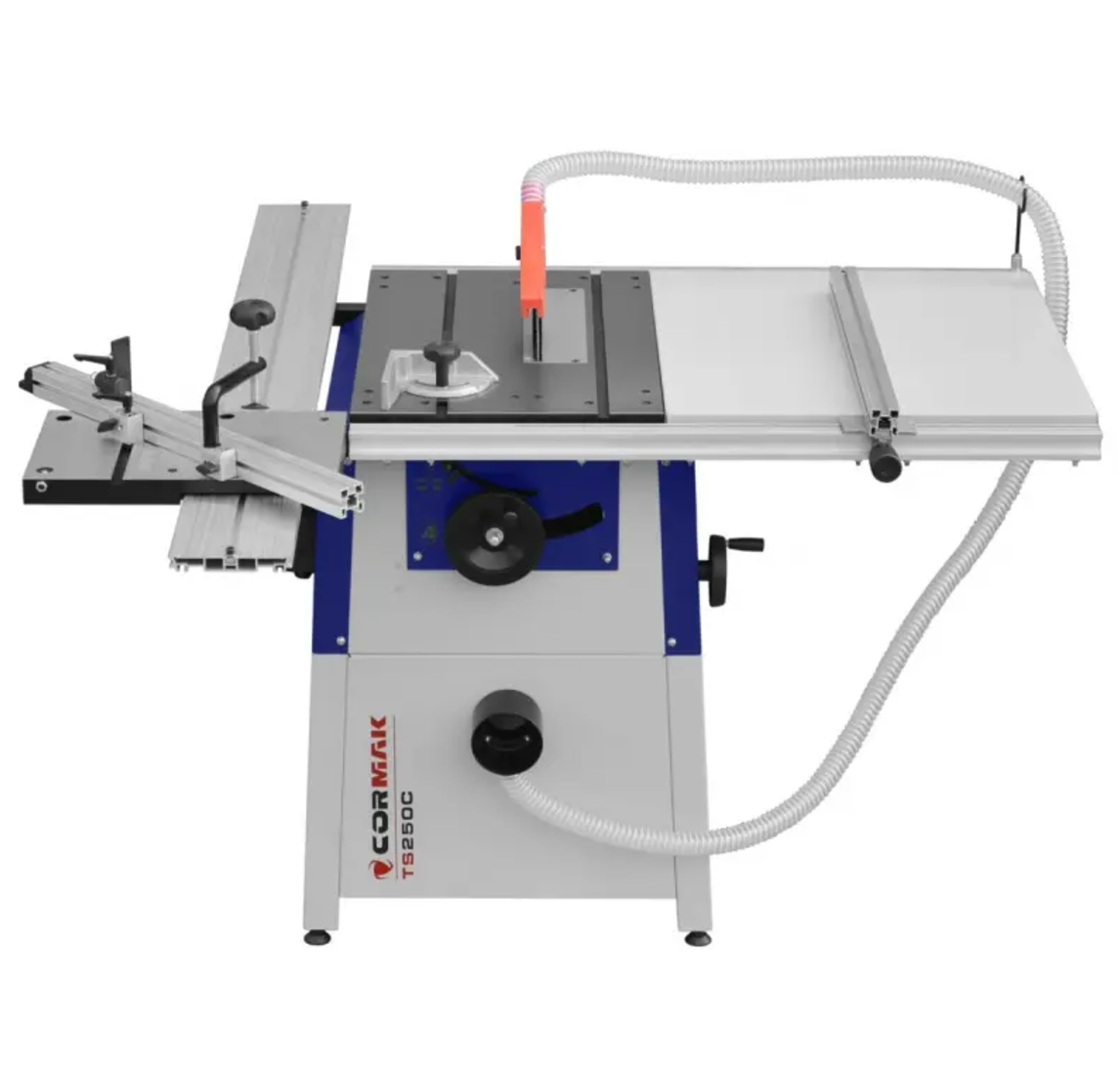
The table saw, also known as a table circular saw, is a tool that has been revolutionising woodworking for over a century. The table saw design emerged in the late 19th century alongside the rise of mechanisation, enabling precise cuts that had previously been difficult to achieve without complex machinery. Over the decades, it has evolved – from hand-powered and belt-driven models to modern electric and petrol-powered versions. Today, the table saw is indispensable in professional workshops, as well as in home workshops and on farms. Understanding its construction, applications and key technical parameters, such as optimal speed, allows for the safe and effective use of this extremely versatile tool.
The table saw, also known as a table circular saw, is a tool that has been revolutionising woodworking for over a century. The table saw design emerged in the late 19th century alongside the development of mechanisation, enabling precise cuts that had previously been difficult to achieve without complex machinery. Over the decades, it has evolved – from hand-powered and belt-driven models to modern electric and petrol-powered versions. Today, the table saw is indispensable in professional workshops, as well as in home workshops and on farms. Understanding its construction, applications and key technical parameters, such as optimal speed, allows for the safe and effective use of this extremely versatile tool.
In this article, you will learn:
- The angle grinder – what is it?
- The basic structural components of a drill
- How a lathe works
- The use of a bench-mounted lathe and what speed it should run at
- The versatile applications of a dough roller
- What speed should a lathe have – optimal operating parameters
- Which lathe should you choose for your workshop?
- Types of planers by application and size
- Safety when working with a lathe
- Summary
A table saw – what is it?
A table saw is a colloquial term for a table-mounted saw, a device used to cut various types of materials, mainly wood. It consists of a sturdy worktable on which a cutting blade, driven by an electric motor, is mounted. A characteristic feature of a table saw is the ability to precisely set the angle and depth of cut. This makes it a versatile tool for carrying out a wide range of carpentry tasks.
The machine is primarily used for precise cutting of wood – both rip and cross cuts – although, depending on the cutting disc used, it can also successfully process other materials.
Basic structural components of a mitre saw
Understanding the construction of a mitre saw enables its proper use and the informed selection of a machine to suit specific needs. The design of a mitre saw is based on several key components that work together to ensure precision and safety during operation. Each of these components performs a specific function and has a direct impact on the performance and durability of the entire machine.
- Support frame (base) – made of a metal or cast iron truss, it forms the foundation of the entire machine. The cast iron construction ensures exceptional stability and vibration damping during operation, which directly translates into cutting precision. In domestic models, the base may be made of lighter materials, but a professional table saw always features a solid, deformation-resistant frame.
- Work surface – usually made of steel or aluminium, it forms the surface over which the workpiece moves. Steel surfaces are more resistant to mechanical damage, whilst aluminium ones are lighter and corrosion-resistant. In domestic versions, wooden worktops are also found, though they are not recommended for applications requiring high precision.
- The shaft with the cutting disc – this is the heart of every band saw. A steel cutting disc is mounted on the drive shaft, equipped with teeth of the appropriate shape and number, selected to suit the type of material being cut. The disc is a replaceable component, which allows the machine to be flexibly adapted to various tasks.
- Drive motor – depending on the intended use of the edger, either three-phase electric motors (powered by 400V) or internal combustion engines are used. Three-phase motors are predominant in workshop and industrial settings due to their operational stability and high power output. Internal combustion engines are mainly used in mobile machines operating in the field without access to the mains supply.
- Blade guard – a safety feature protecting the operator from contact with the rotating blade. The guard is usually adjustable and lifts automatically when material is fed into the cut.
- Control system – comprises switches, speed controllers and start-up systems. Professional machines use star/delta starters, which ensure safe motor start-up and protect the motor from overload.
- Safety systems – modern circular saws are equipped with overload sensors, drive locks and electrical enclosures that protect against moisture and dust. All cables and electrical components should be properly sealed and housed in watertight boxes.
How a brush cutter works
The principle of operation of a circular saw is based on the rotational movement of the cutting disc, driven by an electric or combustion engine. The motor transmits torque to the shaft to which the disc is attached – the blade rotates at high speed, and the teeth of the disc successively cut into the material, separating successive layers from it. The direction of the blade’s rotation is always such that the teeth work from bottom to top at the point of contact with the material, which ensures that the workpiece is pressed against the worktable.
The robust construction of the table ensures the stability of the entire system during operation, minimising vibrations and ensuring a straight cut. Thanks to the parallel and cross guides, the operator can precisely set the width or angle of the cut, allowing for the consistent production of components with identical dimensions. The ability to adjust the blade tilt angle – typically up to 45 degrees – enables the execution of mitre cuts, essential for the production of furniture or structural components. It is precisely this combination of a stable base, a precise material guidance system and a reliable drive that makes a professional mitre saw an indispensable tool for working with wood and many other materials.
Applications of a table mitre saw and what speed it should have
A mitre saw is a machine with an exceptionally wide range of applications, proving its worth in professional joinery workshops as well as in domestic settings or on construction sites. The applications of a mitre saw include cutting a variety of materials – from wood and plastics to metals and composite materials. It is this versatility and precision of operation that make it an indispensable tool wherever fast and accurate cutting of materials to specific dimensions is required.
Versatile applications of the mitre saw
The primary and most common use of a rip saw is woodworking. The machine allows for both rip cutting, i.e. cutting boards and beams along the grain, and cross-cutting, which involves shortening wooden elements to the desired length. As a result, a table saw for wood is essential equipment in any joinery or sawmill.
In addition to processing solid wood, the machine handles wood-based materials such as MDF, plywood, chipboard and OSB with ease. This makes it indispensable in furniture production, where precise panel sizing is crucial to the quality of the final product. What is a table saw in an industrial context? It is, first and foremost, a machine enabling the mass and repeatable production of components with identical dimensions. A small table saw is suitable for smaller workshops and domestic use, where cutting very large formats is not required. In industry and professional joinery, however, a larger, stationary table saw is indispensable, providing the necessary power and stability during intensive use. The table saw’s versatility means it is often the first tool purchased for a new workshop.
What speed should a mitre saw have – optimal operating parameters
One of the key parameters determining work efficiency and safety is the rotational speed of the cutting disc. What speed should a circular saw have? This is a question every user asks themselves when faced with choosing or configuring a machine. The answer depends primarily on the type of material being cut and the diameter of the disc used.
For wood, a rotational speed of 3,000–5,000 revolutions per minute is recommended. This speed ensures effective cutting without the risk of scorching the material or overheating the blade. In practice, most circular saws driven by a 400 V three-phase motor achieve speeds in the range of 2,000–4,000 rpm, which, combined with the appropriate selection of pulleys, allows for optimal cutting performance.
The diameter of the cutting disc is also of significant importance. For a disc with a diameter of 550 mm, the maximum speed should not exceed 2,800 rpm – higher speeds risk overheating, blunting the teeth and reducing operational safety. The general rule is simple: the larger the blade, the lower the permissible speed should be. The range of 1,440–2,880 rpm is typical for heavier blades used in industrial stationary saws.
Which angle grinder should you choose for your workshop?
Choosing the right angle grinder for a workshop is a decision that should be preceded by a thorough analysis of your needs, the type of work to be carried out and the available workspace. Machines with a wide range of specifications are available on the market – from compact workshop tools to powerful industrial angle grinders. Understanding the design of the edging machine and its key technical specifications allows you to make an informed choice, which will translate into productivity and workplace safety.
Types of angle grinders by application and size
Angle grinders can be divided into several main categories, differing in disc diameter, motor power and intended use. Each of them meets different user needs – whether for a hobbyist, a professional carpenter or an industrial plant.
- Small workshop circular saws – characterised by a blade diameter of 250 to 350 mm and a motor power of 1 to 2 kW. These machines are designed for lighter work, making them ideal for home workshops and less demanding projects. A small wood mitre saw of this type is perfect for cutting boards, battens or furniture components.
- Universal circular saws for DIY enthusiasts – lightweight and relatively easy-to-use machines that combine portability with decent performance. They are suitable for DIY applications where the highest precision or continuous, intensive work is not required.
- Precision and format circular saws – designed for advanced joinery work requiring high cutting accuracy. They are used in furniture production and the processing of wood-based panels, where every millimetre counts.
- Large industrial circular saws – these are machines with a blade diameter exceeding 600 mm and a motor power exceeding 4 kW. They are ideal for applications in the timber industry, where high performance is required, along with the ability to cut thick, hard materials for long periods without downtime.
When selecting a motor for a circular saw, it is worth remembering that its power should be at least 4 kW, and the speed around 1440 rpm. Such a motor ensures appropriate cutting speeds, whilst reducing wear on belts and bearings thanks to the possibility of using larger pulleys – which directly translates into the durability of the entire machine.
When deciding to make a purchase, it is worth opting for equipment from reputable manufacturers. CORMAK, as an experienced manufacturer of industrial machinery, offers band saws with an exceptionally good value for money, as well as transparent warranty terms and the option to purchase optional equipment.
Safety when working with a slitting machine
Working with a band saw requires adherence to safety rules that minimise the risk of accidents. Here are a few basic rules:
- use of protective guards – the cutting disc should always be covered when the machine is switched on;
- appropriate clothing – avoid loose clothing and jewellery that could get caught in the mechanism. You should also wear protective gloves to reduce the risk of cuts. Safety goggles are another essential item that every circular saw user should have;
- keeping the workplace tidy – a clean and tidy workstation reduces the risk of accidental injuries. All unnecessary items should be removed from the work surface to ensure maximum control over the material being cut;
- regular maintenance – regularly checking the technical condition of the machine, including the blade and drive mechanisms, ensures safe operation. It is also important to lubricate moving parts periodically to prevent premature wear.
Familiarising yourself with the user manual and receiving training in the use of the circular saw is key to safe and effective operation. It is also advisable to follow ergonomic principles to avoid straining muscles and joints during prolonged use of the machine.
Summary
A table saw is a versatile tool useful in any carpentry workshop. Thanks to its precision and the ability to adjust operating parameters, it is used in both professional workshops and home workshops. A properly selected table saw allows you to tackle the most demanding carpentry projects, whilst ensuring safety and comfort at work. Check out CORMAK’s range of table saws and see for yourself how the right equipment can significantly boost your productivity.
