


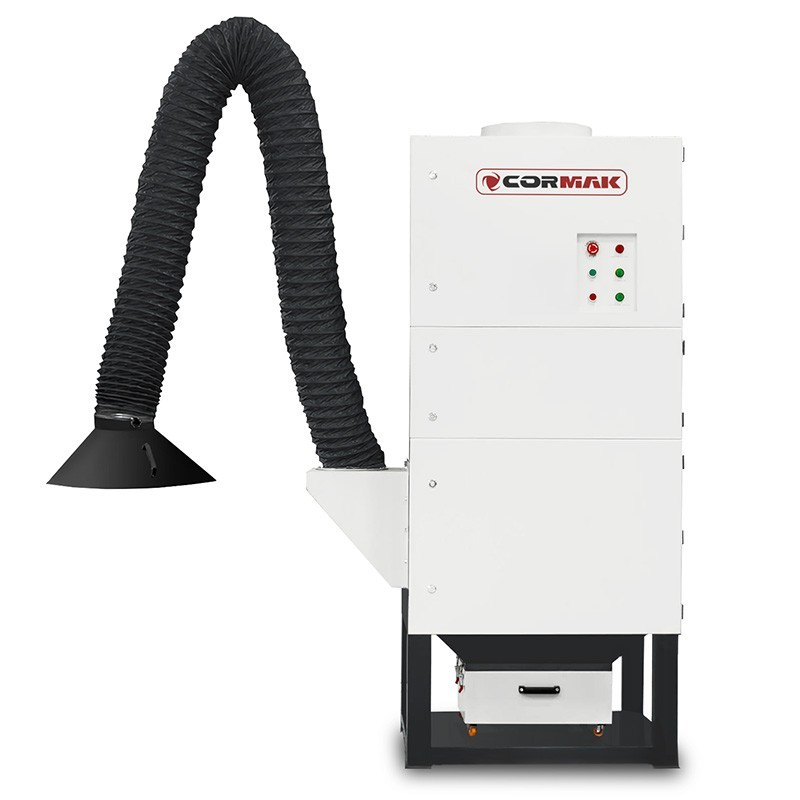
A welding extractor removes fumes and dust generated during welding, grinding and other metalworking operations. For the system to effectively limit the spread of pollutants, its capacity must be tailored to the workstation, the welding technology and the intensity of the work. An extraction system that is too weak will not capture a sufficient amount of fumes, whilst an oversized unit may generate unnecessary noise, higher energy consumption and increased running costs.
Welding fume extraction – how to choose the right capacity?
A welding fume extractor removes smoke and dust generated during welding, grinding and other metalworking operations. For the unit to effectively limit the spread of pollutants, its capacity must be tailored to the workstation, the welding technology and the intensity of the work. An extraction system that is too weak will not capture a sufficient amount of fumes, whilst an excessively large unit may generate unnecessary noise, higher energy consumption and increased running costs.
When making a selection, one should not rely solely on the maximum air flow rate specified in cubic metres per hour. Equally important are the design of the arm, the type of filters, pressure drops, the distance of the suction nozzle from the weld, and the number of workstations to be operated simultaneously.
Why does extraction efficiency matter?
Welding fumes rise directly above the weld site. It is therefore most effective to capture it as close to the source as possible, before it disperses throughout the workshop. A correctly positioned suction nozzle reduces the amount of pollutants reaching the operator’s breathing zone and the rest of the room.
However, high fan capacity alone does not guarantee good results. If the arm is positioned too far away, the ductwork is leaking, the filter is heavily soiled, or the workstation is poorly laid out, the actual suction force at the weld may be significantly lower than the catalogue value.
Therefore, welding fume extraction should be assessed as a complete system: the fan, filters, hoses, extraction arm, the geometry of the nozzle and its positioning relative to the welding site.
Type of welding process
The amount of fume generated depends on the technology used. MIG/MAG welding, particularly at higher intensities and with coated materials, can generate significantly more fumes than light TIG welding. A greater need for effective extraction can also be expected with long welds, high welding currents and shift work.
Other factors that play a role include the type of electrode or wire, the grade of material, the surface condition, the length of the welds being made, the number of working hours per day, and additional operations such as grinding, cleaning or spot heating of components.
A workstation used occasionally for short welds will have different requirements to mass production, where the operator welds for most of their shift. The more intensive the process, the greater the airflow and the more effective the filtration the unit requires.
One workstation or several?
A mobile welding fume extractor is most commonly designed to serve a single workstation. It can be easily moved between work areas, but at any given time it should capture fumes from a single source.
If several workstations are operating simultaneously, a multi-arm unit or a central extraction system should be considered. In such cases, it is not sufficient simply to multiply the capacity of a single extraction unit by the number of workstations. Account must be taken of the length of the ducts, flow resistance, the number of bends, the diameters of the ducts, simultaneous operation and pressure losses throughout the entire system.
Each additional arm increases the required flow rate. If the unit has two arms and both are in use simultaneously, the fan must provide adequate suction at both points, rather than merely a high maximum value measured under ideal conditions.
Length and diameter of the extraction arm
The extraction arm should allow the suction nozzle to be positioned as close as possible to the weld, without restricting the operator’s movements. A longer arm increases the working range but may cause greater flow resistance. It is therefore important to select the arm length to suit the actual layout of the workstation, rather than simply the maximum reach.
The diameter of the hose also affects performance. A cross-section that is too small restricts the volume of air transported and may increase noise levels. A nozzle that is too large and positioned too far from the workpiece may draw in a lot of ambient air but fail to capture the fumes directly above the weld.
In practice, correct positioning of the arm often has a greater impact on performance than a slight difference in the capacity of two similar units. Even a powerful extraction system will not work properly if the nozzle is too far from the source of the fumes.
Filters and actual performance
The extraction system should be fitted with filters suitable for the type of contaminants. During operation, dust gradually accumulates on their surface, increasing flow resistance. If the filter is not regularly cleaned or replaced, the unit’s performance drops and the fan has to operate under more difficult conditions.
For intensive use, it is worth choosing a model with an automatic or convenient manual filter cleaning system. The filter area is also important. A larger filter can maintain a stable flow for longer and requires less frequent maintenance.
You should also check how the dust collection container is emptied. Easy access to the filter, drawer or tank streamlines maintenance and reduces workstation downtime. This is particularly important when the extraction system operates daily and supports demanding processes.
How do you choose the right capacity?
It is best to start by determining the number of workstations operating simultaneously and the type of work being carried out. Next, you should take into account the length of the arms, the intensity of welding, the layout of the workstation and the type of filtration.
For a single workstation, a mobile extraction unit fitted with a single arm and flow-rate adjustment is usually sufficient. For two workstations, a unit designed to operate with two arms or two separate extraction units should be used. For a larger number of workstations, it is worth considering a centralised extraction system.
It is advisable to allow for a moderate margin in capacity, particularly where production may expand. Over-sizing the system will not always improve efficiency, as localised fume capture and correct positioning of the extraction nozzle remain key. The best results are achieved by combining the right flow rate, effective filtration and an ergonomic arm.
The most common mistakes when selecting an extraction system
One of the most common mistakes is selecting a unit based solely on the fan’s maximum capacity. Equally problematic is positioning the nozzle too far from the weld, using hoses that are too long, failing to clean the filters regularly, and using a single extraction unit for several workstations operating simultaneously, even though the unit was not designed for this purpose.
It is also a mistake to overlook the nature of the process. A workstation for occasional repairs will have different requirements to mass production, the welding of large structures or working with materials that produce heavy smoke.
Summary
The performance of a welding fume extraction system must be tailored to the type of welding, the number of workstations, the length of the arm and the intensity of operation. The air flow rate alone is not sufficient to assess the system.
An effective extraction system should capture fumes as close to the weld as possible, maintain a stable suction force even when the filter becomes dirty, and allow for convenient adjustment of the arm’s position. A well-chosen system improves workstation organisation, limits the spread of dust and promotes safer working conditions in workshops and production facilities.
