


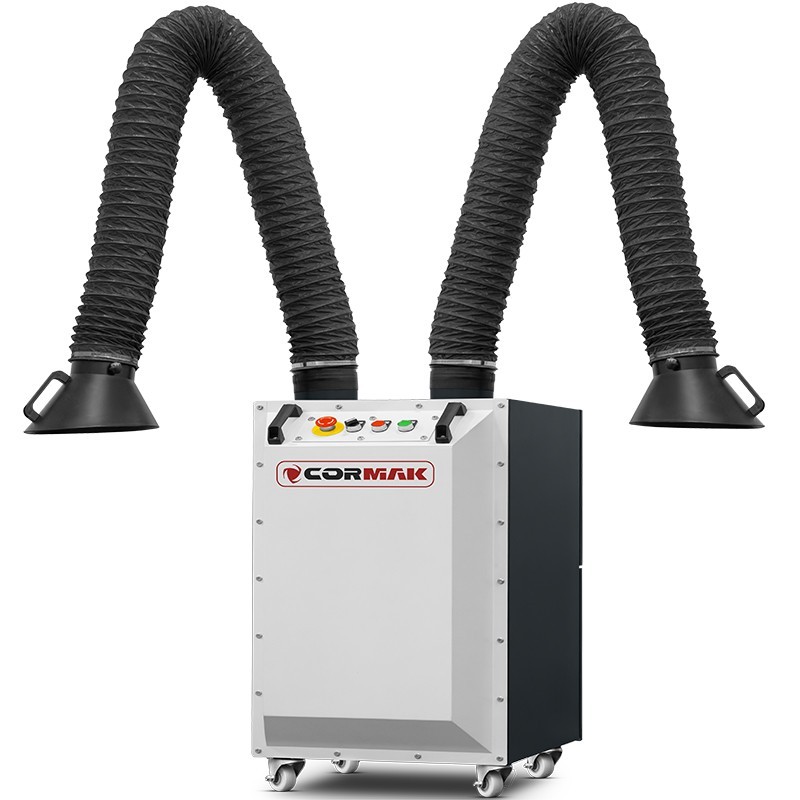
A welding fume extraction system is a component of a system designed to minimise exposure to fumes and dust generated during welding. A well-designed system for capturing contaminants at source helps to improve working conditions, visibility at the weld and the cleanliness of the workstation.
Welding fume extraction – how to choose a solution for safer working conditions?
A welding fume extraction system is a component of a system designed to minimise exposure to fumes and dust generated during welding. Well-designed source capture helps to improve working conditions, visibility at the weld joint and the cleanliness of the workstation.
The choice of equipment should not be based solely on fan power or the declared airflow rate. Key factors include the type of welding process, the material and coatings, the number of workstations, the working position, the method of fume extraction and the planned maintenance of the filters.
What is welding fume extraction?
A welding fume extraction system is a local or workstation ventilation system designed to capture fumes and dust as close as possible to the point of generation. It usually consists of a capture element, ductwork, a fan, a filter module and an exhaust system or – in suitably designed systems – a system for returning purified air.
Welding fumes may contain very fine particles and compounds that depend on the material being welded, the process and the filler materials used. This is precisely why a single ‘one-size-fits-all’ choice of equipment is not sufficient: the system should be based on a risk assessment and the conditions of the specific workstation.
Extraction does not replace other protective measures. It is one element of the hierarchy of exposure control, alongside proper work organisation, general ventilation, personal protective equipment and monitoring the technical condition of the installation.
Why is welding extraction important?
During welding, fumes, dust and gases may be generated, the composition of which depends on the welding process, the base material, the welding wire or electrode, and any coatings on the surface. Reducing workers’ exposure should primarily take place at the source of the emissions.
A well-designed system can help to:
- reducing the spread of pollutants in the welder’s breathing zone;
- better visibility whilst welding;
- a cleaner workstation and less dust build-up on machinery and equipment;
- a more organised workflow at multiple workstations;
- the implementation of measures arising from occupational risk assessments and health and safety regulations.
Effectiveness depends primarily on whether the extraction unit is correctly positioned in relation to the source of fumes and whether the system is used and maintained correctly.
Types of welding extraction systems
Local extraction systems with an extraction arm
The extraction arm allows the nozzle to be positioned close to the welding site. This is a common solution for permanent or semi-permanent workstations, particularly where the welding position and size of workpieces vary only within a limited range.
- the ability to position the extraction point at the source;
- good access to the workstation;
- can be connected to a central extraction system or a filtration unit.
Welding tables with extraction
A table with extraction integrates the work surface with a fume extraction system. It may be suitable for workpieces whose dimensions are compatible with the table and where the work is repetitive in nature.
- a compact solution for a single workstation;
- extraction from below or through slits in the worktop;
- easier to maintain a constant position of the workpiece.
Centralised systems
A centralised system is designed to serve multiple workstations. It requires a design that takes into account simultaneous operation, system resistance, the type of contaminants, filter selection, automation and the safe management of filter waste.
- support for multiple extraction points;
- capability for centralised control and monitoring;
- the need for professional design and balancing of the system.
Mobile welding fume extraction units
Mobile filtration units are useful where workstations change location or where short runs of work are carried out. Their effectiveness depends on the correct positioning of the arm or suction nozzle, as well as on the performance and condition of the filters.
- flexible use at various points within the workshop;
- no need to construct an extensive duct network;
- the need to provide space, a power supply and regular maintenance of the filters.
Extraction from the welding torch
In some processes, welding torches with integrated fume extraction can be used. This solution can reduce emissions at the source itself, but requires proper adaptation to the welding method, work ergonomics and extraction parameters.
What should you look out for when choosing a welding extraction system?
Type of process and material
The selection should take into account the welding method, the type of metal, filler materials, coatings and any preparations carried out prior to welding. Other risks may arise when working with stainless steel, galvanised components, painted components or components contaminated with oil.
Number of workstations and simultaneous operation
Airflow and the size of the unit should be determined based on the actual working scenario. In a centralised system, it is crucial to establish how many workstations are operating simultaneously and what the requirements are for each extraction point.
Capture efficiency
It is essential to capture smoke as close as possible to the arc or the point of emission. If the extraction nozzle is too far away, or if there are unfavourable draughts or an obstacle between the smoke source and the nozzle, this can significantly reduce the system’s efficiency.
Capacity, pressure and flow resistance
Fan parameters must be analysed in conjunction with the length of the ducts, the number of bends, the duct diameters, filters and extraction elements. A high flow rate specified for the unit alone does not guarantee effectiveness in the finished installation.
Noise, ergonomics and service access
It is worth checking the noise level, the reach of the arm, how easy it is to position, access to filters, the method of emptying containers, and the availability of consumables and servicing.
Filtration, exhaust and recirculation
The type of filtration should be selected according to the type of contaminants and the process requirements. In practice, the system may utilise mechanical filtration, cartridges of a specific class, spark separation or other solutions specified by the manufacturer. Activated carbon filters are primarily used for specific gases and odours, rather than as a universal substitute for particle filtration.
The decision on whether to discharge air to the outside or to recirculate it requires a technical analysis, a risk assessment, compliance with regulations and the manufacturer’s instructions. In particular, consideration must be given to the composition of the pollutants, filtration efficiency, the method of monitoring filter condition, and the requirements for supply air.
In the case of processes generating sparks or hot particles, additional fire and explosion protection measures may be necessary. These should be selected to suit the specific process and the properties of the dust, rather than assuming that any standard filter will be suitable.
Welding extraction and health and safety
The employer should identify hazards, assess occupational risks and implement measures to minimise workers’ exposure. In practice, this means that the design of the ventilation and extraction system should be based on actual working conditions, exposure measurements or assessments, and workstation-specific instructions.
Local exhaust ventilation is particularly valuable as it removes contaminants close to the source. General ventilation can support it, but should not usually be regarded as the sole solution for processes generating significant amounts of fumes.
Personal protective equipment, including appropriately selected respiratory protection, can provide an additional layer of protection. However, it should not replace effective emission control and contaminant capture where technically feasible.
Operation and maintenance
Even a properly selected extraction system will not be effective without correct operation. The maintenance schedule should be based on the manufacturer’s instructions, the intensity of use and the type of pollutants.
- regularly check the position of the suction nozzle or arm in relation to the source of fumes;
- check the condition of filters, hoses, seals and capture elements;
- clean or replace the filter cartridges in accordance with the instructions and safe waste handling procedures;
- do not obstruct grilles, connections or safety components;
- carry out periodic inspections and measurements as required for the system and the workplace;
- train operators in the correct setting up and use of the extraction system.
The most common mistakes in selection and use
- Positioning the suction nozzle too far from the source: capture efficiency decreases sharply with distance.
- Selection based solely on the m³/h rating: the entire system must be taken into account, including the resistance of ducts and filters.
- Using filters unsuitable for the contaminants: the type of filter cartridge must be appropriate for the process and comply with the manufacturer’s instructions.
- Neglecting maintenance: dirty filters and leaks reduce efficiency and increase operating costs.
- Ignoring draughts: uncontrolled airflow can push smoke away from the extraction point into the breathing zone.
- Treating the extraction system as the sole form of protection: the system should form part of a wider health and safety programme.
Mobile extraction, extraction arm or centralised system?
| Solution | Best use | Strengths | What to watch out for |
|---|---|---|---|
| Mobile extraction | Variable workstations, shorter production runs | Flexibility, no need for a permanent duct system | Positioning, filter capacity, access to power supply |
| Extraction arm | Fixed or semi-fixed workstation | Capture close to the source, easy to set up | Reach, installation constraints, arm positioning discipline |
| Centralised system | Multiple workstations, production operations | Multi-point operation, central filtration | Design, balancing, simultaneous operation and servicing |
Summary
Welding fume extraction is a key element in organising welding work more safely. The best system is not always the unit with the highest declared flow rate, but rather a solution tailored to the process, materials, workstations and working methods.
Before purchasing, it is worth analysing the sources of emissions, the actual number of workstations in operation, the method of extraction, filtration, servicing and health and safety requirements. The design and commissioning of a larger installation should be entrusted to competent specialists.
