


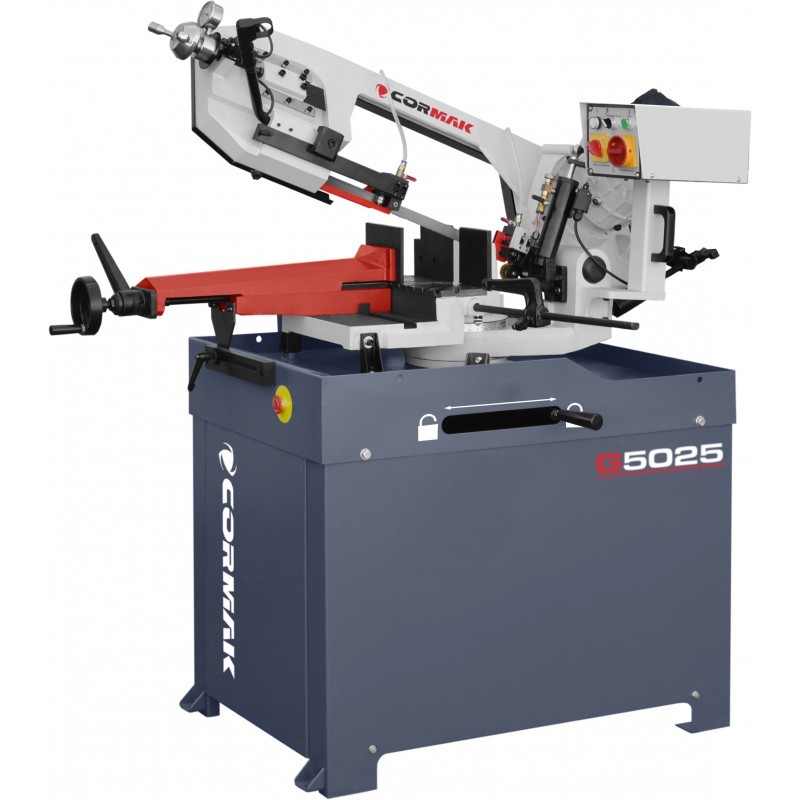
Coolant for a band saw is one of those components that is often treated as an afterthought, yet in practice has a significant impact on cut quality, the service life of the band and the machine’s operational stability. A well-chosen metal band saw can cut with precision and consistency, but without adequate cooling, even a properly selected band saw will lose its sharpness more quickly.
Coolant for a band saw – when is it necessary?
Coolant for a band saw is one of those items that is often treated as an optional extra, yet in practice it has a significant impact on the quality of the cut, the service life of the band and the machine’s operational stability. A well-chosen metal band saw can cut with precision and consistency, but without adequate cooling, even a properly selected band saw will lose its sharpness more quickly.
During cutting, the band’s teeth are subjected to high stress. Friction occurs, the temperature rises, and swarf accumulates in the cutting zone. Coolant dissipates heat, lubricates the band, flushes out swarf and reduces the risk of the material overheating. This makes it easier to maintain a straight edge, the correct cutting angle and a longer tool life.
When is coolant necessary?
Coolant should primarily be used when cutting hard materials, large cross-sections and during batch production. It is particularly important when machining stainless steel, alloy steel, solid shafts, thick flat bars and large-section profiles. Under such conditions, the band remains in contact with the material for a long time, which is why the temperature rises much faster than during light cutting of thin-walled sections.
If a company carries out many repetitive operations, a coolant becomes practically essential. This applies to manufacturing plants, metalworking workshops, service centres and metalworking companies. Regular cooling helps maintain a stable process, reduces wear on metal band saws and minimises the risk of downtime caused by overheating or premature blunting of the band.
It is also worth using coolant when cutting at an angle. In this position, the band remains in contact with the material for longer, which increases friction and the risk of the band straying from the cutting line. Proper cooling helps maintain a straight edge, reduces burr formation and improves the repeatability of subsequent cuts.
Do you always need to use coolant?
Not always. For single, short cuts of thin profiles, it is sometimes possible to work dry. This mainly applies to light assembly or workshop work, where the material does not overheat and the time the band is in contact with the workpiece is short.
However, it is essential to monitor the process closely. A squeaking band, scorching, discolouration, a wavy edge, excessive burr or rapid tooth dulling indicate that the cutting conditions are too demanding for working without cooling. In such a situation, coolant should be used, the feed rate reduced, or the suitability of the band for the material checked.
The machine’s design is also important. Metal band saws differ in terms of motor power, arm rigidity, band guidance, the type of coolant pump and the method of delivering coolant to the cutting zone. Modern band saws equipped with an efficient cooling system allow for better control of temperature, chip removal and the service life of the band.
How does coolant affect cut quality?
The primary function of the coolant is to lower the temperature at the cutting point. An overheated band loses its cutting properties more quickly, and the teeth may suffer micro-damage. High temperatures also impair edge quality, particularly with materials requiring stable cutting parameters.
The second function is lubrication. A layer of coolant reduces friction between the band, the chips and the workpiece. This ensures a smoother cut and reduces the load on the band. This is particularly important when cutting solid bars, stainless steels, alloy steels and workpieces with a large cross-sectional area.
The coolant also helps to flush chips out of the kerf. If chips remain between the teeth, the band may run unevenly, overheat and veer off the cutting line. Efficient flushing helps maintain accuracy and reduces the formation of burrs.
Which coolant should you choose?
A cooling and lubricating emulsion is most commonly used, i.e. a concentrate mixed with water at the appropriate concentration. For standard structural steel, a universal coolant designed for metalworking machines is usually sufficient. For stainless steel, alloyed materials and more challenging cross-sections, it is advisable to use a coolant with better lubricating properties.
You should not use random substances, such as engine oil, technical fluids not intended for machine tools, or mixtures of unknown composition. These can contaminate the system, impair cutting quality, damage the pump or make it more difficult to clean the machine later.
It is important to use the correct emulsion concentration. If it is too weak, it may not provide adequate lubrication and corrosion protection. If it is too strong, it increases running costs and may leave excessive residue on the machine and the workpiece. It is best to set the concentration in accordance with the coolant manufacturer’s recommendations and to monitor it during use.
Maintenance of the cooling system
Even a good coolant will not fulfil its function if the fluid supply system is dirty or blocked. It is advisable to regularly check the nozzles, hoses, filter, pump and the fluid level in the tank. The jet should be directed straight into the cutting zone, rather than running off the material.
Chips and deposits can restrict the flow of coolant. A contaminated emulsion loses its properties, dissipates heat less effectively and may cause an unpleasant odour. Regular fluid changes and cleaning of the reservoir help to maintain stable operating conditions and reduce the risk of pump failure.
Band saw or circular saw?
Many companies are faced with the question of whether to choose a band saw or a circular saw. Band saw solutions work well with a wide range of materials and cross-sections. They ensure relatively low material loss per cut, good cutting control and cost-effective operation, provided the correct band, feed rate and cooling are selected.
Disc cutters can be a good choice for other tasks, for example where very fast cutting of specific profiles is required. In practice, the choice of machine should depend on the type of material, the required accuracy, the number of cuts and the production organisation.
Summary
Coolant is essential when cutting stainless steel, alloy steels, solid materials, large cross-sections, in batch production and when cutting at an angle. For light, individual cuts of thin profiles, dry cutting is sometimes possible, but this requires monitoring of temperature, the sound of the band in operation and the quality of the edges.
A well-chosen coolant, a well-maintained band saw and correctly selected metal band saw blades help to increase cutting accuracy, extend the service life of the band and improve productivity. In workshops and production facilities, cooling should not be treated as an optional extra, but as one of the fundamental requirements for the correct operation of the machine.
