


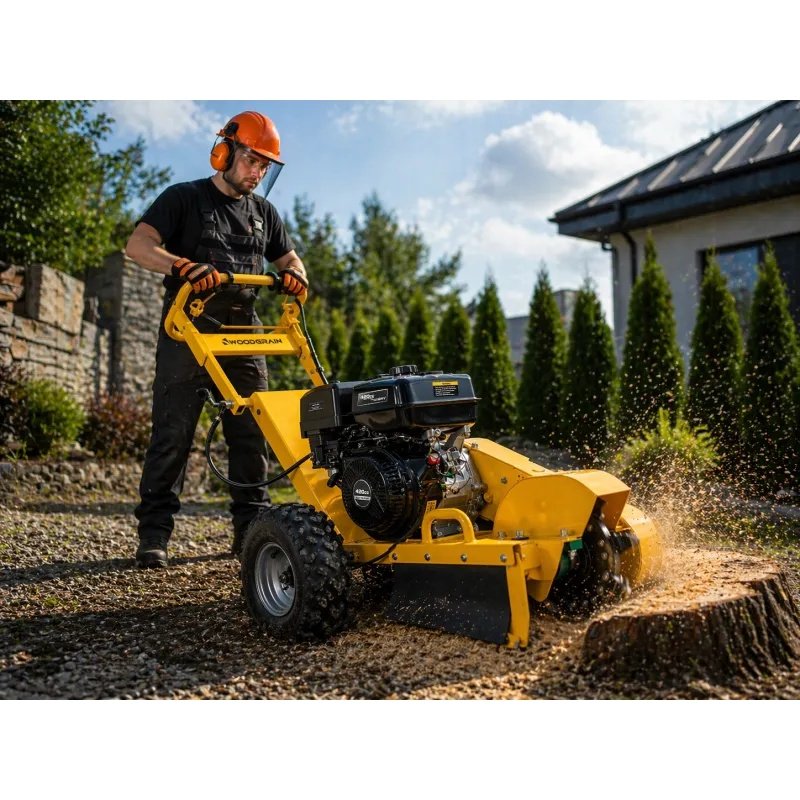
How do you remove a tree stump after felling? Learn the differences between manual digging, mechanical grubbing and stump grinding, and find out which method suits the stump size, root system, machine access and the way the ground will be used after removal.
How to remove a tree stump after a tree has been cut down?
After a tree has been felled, the stump and a more or less extensive root system remain in the ground. These remains can interfere with mowing, new planting, fence construction, surfacing or preparation of the site for further work. Choosing the right stump-removal method is therefore often one of the next stages in clearing the area.
The method should mainly depend on the stump diameter and height, the extent of the root system, access for machinery and the intended future use of the ground. Options include manual removal, mechanical grubbing and stump grinding. For larger jobs, groundworks machinery can also be used.
How do you remove a tree stump mechanically?
The simplest method is to dig out the stump together with as much of the root system as possible. With smaller trees this can be done manually using a shovel, spade, axe, mattock and saw to cut larger roots. Soil is removed around the stump, individual roots are exposed and cut, and the remaining rootstock is gradually loosened.
Manual removal does not require specialist machinery, but it becomes increasingly labour-intensive as stump diameter and root thickness increase. A large old stump can be very heavy and its roots may extend well beyond the visible area.
For larger stumps, an excavator or other suitable machine can be used to expose and pull out the rootstock together with part of the root system. Mechanical grubbing is particularly useful where more complete root removal is necessary, for example before foundations, deep excavation, road construction or other structural work.
The consequences of this method also need to be considered. Pulling out the rootstock creates a larger excavation, disturbs the ground and requires subsequent backfilling and compaction. Heavy machinery also needs sufficient access and working space.
Before any excavation, check for electrical cables, water or gas pipes, telecommunications, irrigation systems and other underground services. This applies to both manual digging and mechanical equipment.
How do you remove a stump without excavating a large area?
If the aim is to remove the visible remains of the tree without creating a large excavation, stump grinding is a practical solution. A stump grinder uses a rotating wheel or head fitted with durable cutting teeth. The operator moves the working element across the stump and removes the wood progressively.
Grinding can continue below ground level. This removes the visible stump and allows the area to be backfilled with soil and prepared for lawn, planting or other landscaping. Because the entire root ball does not need to be pulled from the ground, the disturbance is usually considerably smaller than when an excavator is used.
The work area needs to be prepared before grinding. Stones, pieces of metal, old fence components and other hard objects should be removed because they can damage the cutting teeth or be thrown from the work zone. Underground utilities also need to be checked.
The operator moves the grinding wheel over the stump in accordance with the manufacturer's instructions, removing material layer by layer. The required working depth depends on the capabilities of the machine and the intended use of the ground afterwards.
CORMAK's groundworks machinery range includes equipment intended for stump removal. One example is the FP15, with a 420 cm³ engine producing approximately 12 hp, a 300 mm cutting wheel and 9 carbide cutting teeth. According to its technical specification, it can grind to approximately 225 mm below ground level.
A stump grinder does not automatically remove the entire tree root system. Its primary purpose is to break down the stump and the roots located directly within the cutting wheel's working area. Roots further away or deeper underground can remain in place and gradually decompose naturally.
CORMAK's wider range of industrial and groundworks machinery can also be considered when stump removal forms part of a larger site-preparation project.
How do you remove a tree stump quickly and what should you do with the roots?
How thoroughly the stump and roots need to be removed depends mainly on the future use of the area. It is not always necessary to remove the entire root system from the ground.
If the site will become a lawn, flower bed, garden area or contain a small landscaping feature, it is usually sufficient to remove the above-ground section and grind the stump far enough below ground level. The resulting wood chips can be removed or, where suitable, used as mulch.
The situation is different if foundations, paving, deep excavation, underground services or structures requiring a properly prepared base are planned. Remaining roots may interfere with the work and their later decomposition can affect the soil structure. Under these conditions, more complete mechanical grubbing may be the better approach.
The size and species of the tree also matter. A small ornamental tree may have a relatively straightforward root system, while a large tree can have extensive roots spreading far beyond the stump. The method should therefore not be selected solely according to the diameter of the visible stump.
Removing a stump – key points to check
Before work begins, check:
- stump diameter and height,
- tree species and condition of the timber,
- approximate extent of the root system,
- access for a stump grinder, excavator or other machine,
- underground utilities,
- stones, metal and other foreign objects around the stump,
- soil type and stability,
- distance from buildings, surfaces, fences and plants,
- how the area will be used afterwards.
This preparation makes it possible to select a method without unnecessarily damaging the surrounding area. Grinding is especially useful when the priority is local removal of the stump with limited excavation. More complete grubbing is more appropriate when root removal is necessary for the next stage of construction.
When grinding, the safe working zone specified by the machine manufacturer must be maintained. Eye and hearing protection, suitable clothing and safety footwear should be worn. Bystanders should remain outside the area into which wood chips or other debris could be thrown.
Once the work is complete, the area should be cleaned, backfilled with suitable material and levelled according to the intended future use. If construction is planned, simply filling the hole with loose wood chips is not a substitute for proper ground preparation and compaction.
Summary
How do you remove a tree stump after felling? Small stumps can be exposed manually and their roots cut. Larger rootstocks can be removed mechanically when the ground needs to be cleared more thoroughly, while a stump grinder can quickly break down the stump with considerably less disturbance to the surrounding area.
The key question is what will be built or planted on the site afterwards. Grinding below ground level is often sufficient for lawn or planting. Before foundations, paving or deep groundworks, more extensive root removal may be necessary.
The correct choice of method and equipment affects working time, subsequent reinstatement and the extent of ground disturbance. Before starting, assess the stump, roots, machine access, underground services and the planned future use of the site.
