


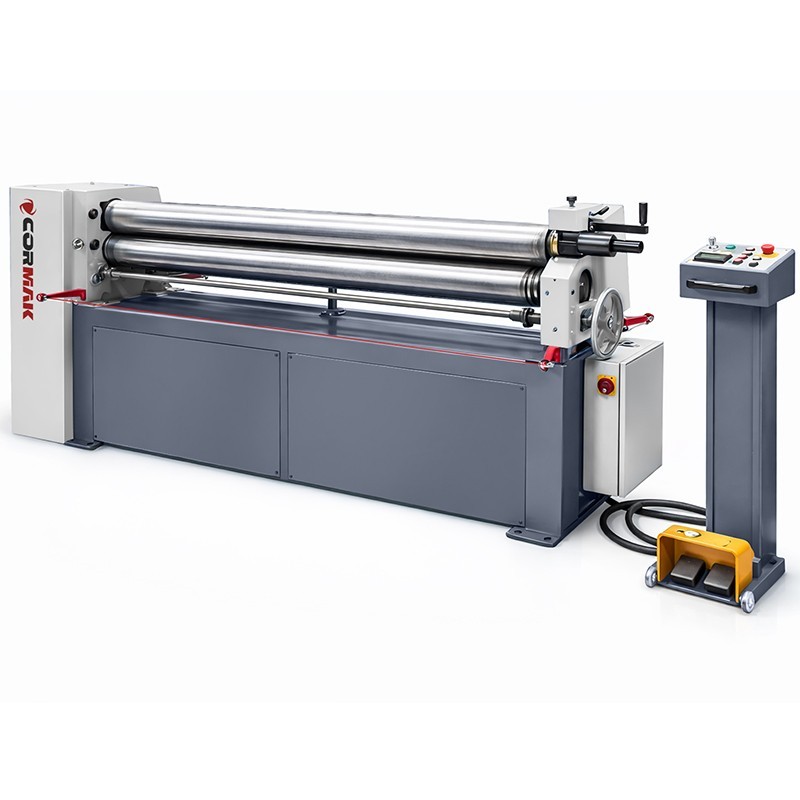
Three-roll or four-roll plate bending machine? Learn how the designs differ and how to choose a machine according to plate thickness, working width, drive type and production volume.
Three-roll or four-roll plate bending machine – which should you choose?
A plate bending machine is used to form sheet and plate into cylinders, arcs, rings, cones, covers and tank sections. These machines are widely used in fabrication, structural steelwork, ventilation and industrial equipment manufacturing.
One of the main decisions is whether to choose a three-roll or four-roll arrangement. CORMAK offers different configurations in its range of rolling mills and plate bending machines.
How does a three-roll machine work?
The plate passes between three working rolls. Adjusting the roll positions progressively bends the material to the required radius.
Asymmetric arrangements can make edge pre-bending easier and help reduce the straight sections left at the beginning and end of the plate.
Machines of this type are available in the mechanical plate rolling machines category.
What are the advantages of three rolls?
Three-roll machines are highly versatile when a workshop processes different plate widths, thicknesses and component diameters.
Typical applications include:
- cylinders and shells,
- ventilation ducting,
- machine guards,
- tank sections,
- boiler components,
- curved structural parts,
- cones.
The RM mechanical bending rolls are examples of three-roll machines intended for workshop and production applications.
Manual, electric or hydraulic?
Manual plate rollers
Best suited to thinner material, smaller parts and occasional work.
Electric plate rollers
A powered drive provides more consistent roll movement and reduces physical effort for the operator.
Hydraulic plate rollers
Hydraulic machines are generally selected for heavier-duty applications, thicker plate and higher forming forces.
How is a four-roll machine different?
The fourth roll provides additional control over the plate during pre-bending and rolling. This can simplify automatic positioning and reduce the need to reposition the workpiece.
These advantages become particularly important in repetitive production with high volumes and tightly controlled cycle times.
The trade-off is a more complex machine, more sophisticated controls and normally a higher capital cost.
Can a three-roll machine be accurate?
Yes. A correctly adjusted three-roll machine can produce consistent radii and repeatable components. Roll alignment, surface condition, material properties and correct feeding all affect the result.
Springback must also be taken into account. A trial component can help establish the correct settings before a production batch begins.
How do you select a plate roller?
Consider:
- maximum plate width,
- maximum thickness,
- material strength,
- required minimum diameter,
- roll diameter,
- drive system,
- production volume,
- cone-rolling requirements.
For heavier-duty electromechanical applications it is also worth comparing the ESR mechanical bending rolls.
When should you choose three or four rolls?
Three rolls
A three-roll machine is particularly attractive for workshops, subcontractors and small-to-medium batch production where flexibility and investment cost are important.
Four rolls
A four-roll machine becomes more attractive when production is highly repetitive and automation, material handling and shorter cycle times have a major impact on throughput.
Summary
Neither design is universally better. A three-roll plate bending machine is often a flexible and economical choice for varied work, while a four-roll machine can provide process advantages in highly automated series production.
The final choice should be based on plate dimensions, material properties, required diameters, batch size and desired level of automation.
