


How to sharpen a tungsten electrode? Learn why grinding direction, tip geometry and angle matter in TIG welding and when a dedicated tungsten electrode grinder is worth using.
How to sharpen a tungsten electrode?
In TIG welding, weld quality depends on more than the welding machine and correctly selected parameters. The condition of the tungsten electrode also affects arc stability, weld-pool control and process repeatability.
Electrode preparation should therefore be a standard part of the TIG workstation. Grinding direction, symmetry, taper length, angle and cleanliness all matter. For regular use, tungsten electrode grinders make it easier to maintain consistent geometry.
Why does the grinding method matter?
The tungsten tip is the point around which the TIG arc forms. Even relatively small differences in tip geometry can affect how the arc starts, where it is directed and how consistently the welder can control the weld pool.
One of the most important rules is to grind the electrode longitudinally. Grinding marks should run parallel to the electrode axis towards the tip rather than around its circumference.
Tip symmetry is equally important. If more tungsten is removed from one side of the taper, the effective arc-emission point can be displaced from the centreline. This is particularly noticeable in precision welding and thin-sheet applications.
The electrode should also be inspected after accidental contact with the weld pool. A contaminated or melted end should be removed and the tungsten prepared again before welding continues.
How do you sharpen a tungsten electrode correctly?
Before grinding, inspect the electrode for contamination, melting or mechanical damage. If the end is heavily damaged, remove the affected section before forming a new point.
- Inspect the tungsten and remove damaged material.
- Use a clean dedicated grinding wheel to reduce cross-contamination.
- Grind along the electrode axis, not across it.
- Maintain a symmetrical taper.
- Control taper angle and length.
- Avoid excessive grinding pressure.
- Inspect the final tip before installing the electrode.
An experienced welder can achieve an acceptable result on a correctly prepared conventional grinding station for occasional work. When electrodes are prepared repeatedly, however, consistency becomes increasingly important.
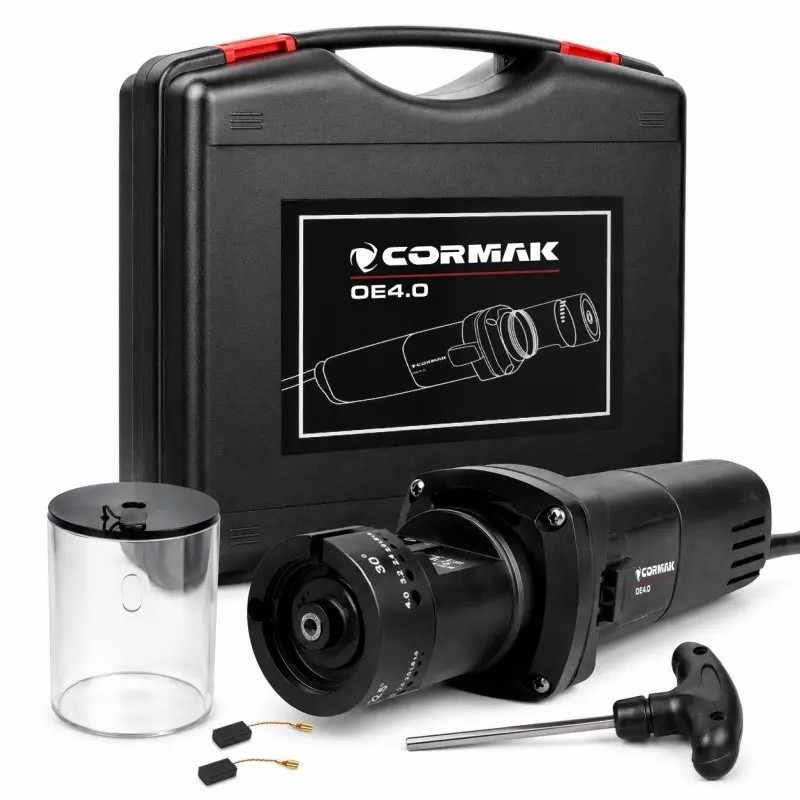
A dedicated unit such as the CORMAK OE4.0 tungsten electrode grinder is designed for repeatable preparation of TIG electrodes from 1 to 4 mm in diameter.
Which grinding angle should you choose?
There is no single grinding angle that is optimal for every TIG application. Electrode type and diameter, welding current, material, joint type and the desired arc characteristics all influence the selected geometry.
A sharper geometry is commonly used where a concentrated, accurately directed arc is required. At higher current levels, the geometry must also allow the tip to remain sufficiently stable under the applied load.
Taper length matters as well as the nominal angle. Two tips that appear to have a similar angle but have significantly different taper lengths may not behave identically.
The CORMAK OE4.0 provides defined angle settings of 15°, 18°, 22.5° and 30°. This allows an established geometry to be reproduced more easily across multiple electrodes.
The appropriate setting should nevertheless be selected according to the welding procedure, electrode manufacturer's recommendations and the requirements of the job rather than simply choosing one of the available grinder positions.
Common tungsten-grinding mistakes
Many electrode problems are caused by preparation rather than the tungsten itself. One frequent mistake is using a grinding wheel that has previously been used on steel, aluminium or other materials. Foreign particles can then contaminate the tungsten surface.
Other common mistakes include:
- grinding across the electrode rather than longitudinally,
- creating an asymmetric taper,
- using a different angle each time,
- applying excessive pressure to the wheel,
- continuing to use a contaminated electrode after touching the weld pool,
- using a heavily worn or dirty grinding surface,
- failing to inspect the finished tip.
In production environments, differences between operators can become another source of variation. Defining one electrode-preparation standard for a particular process helps reduce this unnecessary variable.
Grinding dust also needs to be controlled as part of normal workshop safety. The appropriate procedures may depend on the specific tungsten electrode composition being used.
Dedicated tungsten grinder or standard grinder?
A conventional grinder can be sufficient for occasional TIG work if a suitable clean wheel is used and the operator follows the correct technique. However, repeating exactly the same taper and angle manually is more difficult.
A dedicated tungsten electrode grinder guides the electrode in a controlled relationship to the grinding wheel. This makes it easier to create an axial grind and reproduce the selected tip geometry.
In regular production, this can also reduce preparation time. When several electrodes are sharpened every day, small time savings on each operation can improve overall workstation organisation.
Electrode preparation is only one part of a complete welding workstation. CORMAK also offers a broader range of welding equipment and welding machines for professional workshop and production applications.
Summary
Correct tungsten electrode sharpening requires longitudinal grinding, a symmetrical tip, a clean abrasive surface and a consistent angle matched to the welding process.
A contaminated or damaged electrode should be re-prepared rather than used with a melted or dirty tip.
A carefully arranged conventional grinder may be sufficient for occasional welding. For regular TIG production, a dedicated tungsten grinder makes it easier to standardise preparation, reduce setup time and produce consistent electrodes for each welding cycle.
