


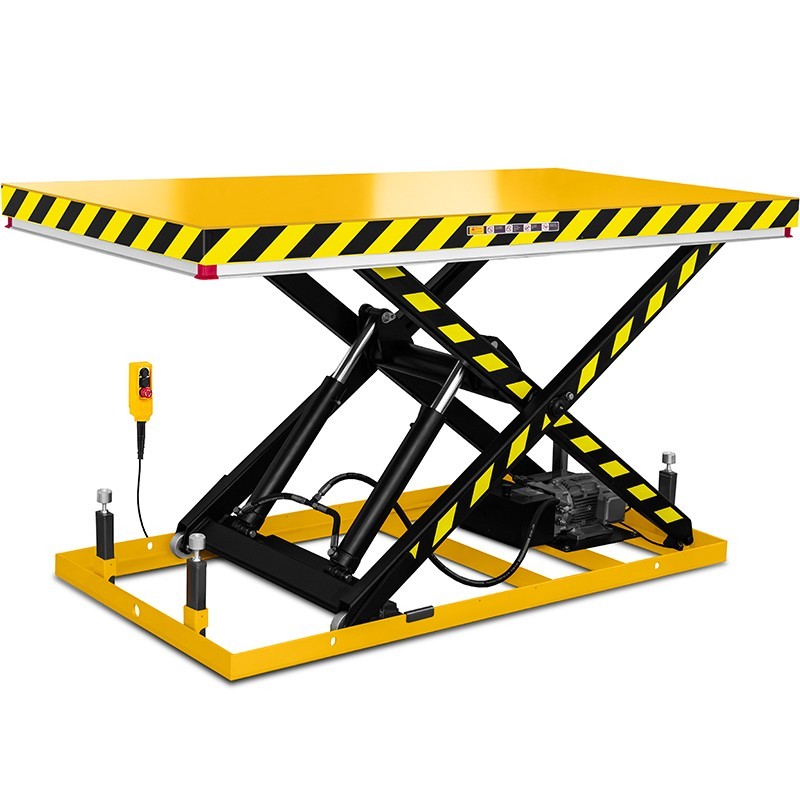
A scissor lift table is used to raise, lower and move heavy loads. It allows materials, parts, containers or equipment to be positioned at a height that is convenient for the operator. As a result, it makes work easier in warehouses, workshops, production facilities, logistics centres and assembly departments.
A scissor lift table is used to lift, lower and move heavy loads. It allows material, parts, containers or equipment to be positioned at a height that is convenient for the operator. This makes work easier in warehouses, workshops, production facilities, logistics centres and assembly departments.
Depending on its design, it can function as a mobile transport trolley, an adjustable workstation or a stationary lifting platform. Its use helps to reduce the manual handling of heavy items, the need for staff to bend down frequently, and the unnecessary transfer of loads between workstations.
A scissor lift does not replace a forklift truck or high-bay storage equipment. Its primary purpose is internal transport and levelling the height between the floor, a workbench, a rack, a machine, a ramp or a conveyor.
How does a scissor lift work?
Beneath the work platform is a mechanism consisting of intersecting arms. Their arrangement resembles a pair of scissors, which is where the equipment gets its name. Extending the arms raises the platform, whilst folding them allows it to be lowered.
In basic models, movement is provided by a hydraulic system operated by a foot pump. The operator presses the pedal and the platform rises gradually. Lowering is achieved using a lever that releases the hydraulic system.
In electric models, the hydraulic pump is driven by a motor. This solution reduces the effort required by the operator and speeds up the execution of successive cycles. It is particularly suitable for intensive work and the regular lifting of heavy loads.
Mobile scissor lifts are fitted with wheels, a handle for manoeuvring and brakes. Stationary models, on the other hand, are installed in a fixed location, for example alongside a production line, at an assembly station or at a transhipment point.
Using a scissor lift table in a warehouse
In a warehouse, a scissor lift table can be used to transport parcels, containers, parts, tools, consumables and small palletised loads. It facilitates transport between the goods reception area, racking, order picking, packing and dispatch.
The greatest benefit is the ability to adjust the platform height to match the level of a shelf, worktop or conveyor. Instead of lifting a heavy container off the floor, the operator can raise it using the table and move it onto an adjacent surface.
The equipment also proves useful during order picking. Containers of goods can be positioned at waist height, so the worker does not have to constantly bend down. With a large number of repetitive tasks, this improves the ergonomics of the entire workstation.
A scissor lift table can also assist with product packaging. A finished item can be raised to worktop level, secured in a cardboard box, and then transported to the dispatch area without the need for further manual handling.
Scissor lift tables in production and assembly
In production facilities, the table can serve as an adjustable workstation. Components, machine parts, moulds, containers with components or items intended for quality control are placed on its platform.
The operator adjusts the height of the platform to suit the type of work being carried out. This facilitates screwing, assembly, drilling, packing and inspecting parts. The table can be raised or lowered during the process without the need to move it to another workstation.
The scissor lift table is also used in machine operation. It can facilitate feeding material into a machine tool, removing finished parts and replacing heavy tooling. The platform can be positioned at the same level as the machine table and the workpiece can be moved carefully.
Such an application requires the platform’s dimensions, load capacity and lifting range to be tailored to the task. The table should provide stable support for the entire workpiece, and the load should not protrude beyond the platform in a way that hinders safe manoeuvring.
Mobile or stationary table?
A mobile scissor lift table is a good choice when loads need to be moved between several workstations. It combines the functions of a lift and a transport trolley. It is ideal for use in warehouses, service centres, workshops and production environments with variable layouts.
When choosing a mobile model, it is worth paying attention to the diameter and material of the wheels. Small wheels can make it difficult to navigate over thresholds and uneven surfaces. Larger wheels ensure easier manoeuvring but may increase the minimum platform height.
The quality of the brakes is also important. The table must remain stationary during loading, unloading and lifting.
A stationary scissor lift table is installed in a fixed location. It can be integrated with a production line, a roller conveyor, a ramp or an assembly station. Such designs often offer a larger platform, a higher load capacity and a wider working range.
How do you select the lifting capacity of a scissor lift table?
The lifting capacity should exceed the maximum weight of the load being lifted. The equipment should not be used regularly at the very limit of its capacity.
If the heaviest component weighs 400 kg, a model with a load capacity of exactly 400 kg provides no margin for safety. The weight of the container, pallet, clamp or additional equipment must also be taken into account.
The position of the centre of gravity is also important. The lifting capacity is usually specified for a load distributed evenly across the platform. A heavy item positioned at one edge may place a different load on the mechanism than a load placed centrally.
Before starting work, you should therefore check the manufacturer’s recommendations regarding load distribution and how to use the table.
Lifting range and platform size
The minimum height specifies how low the platform can be lowered. This is important when loading from floor level and when manoeuvring the table under an item.
The maximum height should correspond to the level of the machines, tables, racks or conveyors to be used with the lift. Before purchasing, it is worth measuring all the workstations with which the lift will be used.
The platform must provide stable support for the load. If the surface area is too small, the workpiece may protrude beyond the edges. Conversely, a structure that is too large will make manoeuvring in narrow aisles difficult.
Manual or electric drive?
A manual hydraulic table is practical for occasional use and a small number of cycles. It has a simple design, requires no charging and can be easily used in various parts of the workshop.
The electric model is more convenient for frequent lifting. It reduces the effort required by the operator and allows for quicker height adjustment. However, you need to monitor the battery’s condition and ensure there is space for safe charging.
The choice of drive system should depend on the weight of the loads, the number of cycles, the intensity of daily work and the layout of the workstation.
Safe use of the scissor lift
The load must be positioned stably and as centrally as possible. Do not exceed the maximum load capacity or transport unsecured items that could slide off the platform.
Before starting work, check the condition of the wheels, brakes, platform, hydraulic hoses and lifting mechanism. The brakes must be applied during loading and unloading.
The platform must be operated on a level and paved surface. Avoid making sharp turns whilst the load is raised high. The higher the centre of gravity, the greater the risk of losing stability.
A standard scissor lift is not designed to lift people. Such use is permitted only for equipment specifically designed and appropriately marked for this purpose.
Summary
A scissor lift is used for lifting, lowering and moving heavy loads. It is used in warehouses, production, assembly, workshops and service centres.
The mobile model facilitates transport between workstations, whilst the stationary model can function as part of a production line. When selecting a model, one should take into account the load capacity, lifting range, platform size, type of drive and floor conditions.
A well-chosen scissor lift table streamlines internal transport, improves workstation ergonomics and reduces the need for manual lifting of heavy items.
