


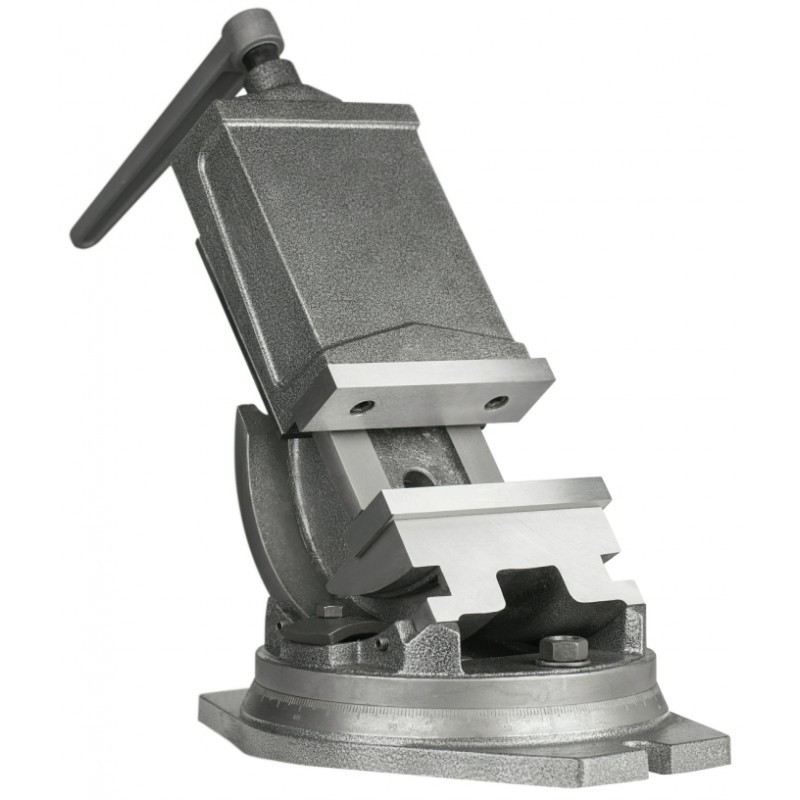
A machine vice is one of the most important pieces of equipment on a milling machine. It ensures that the workpiece is clamped securely, and thus has a direct impact on machining accuracy, surface quality and workplace safety. Even a high-precision milling machine will not be able to reach its full potential if the workpiece moves, vibrates or is clamped unevenly.
A machine vice is one of the most important pieces of equipment for a milling machine. It ensures that the workpiece is held securely in place, and thus has a direct impact on machining accuracy, surface quality and workplace safety. Even a high-precision milling machine will not reach its full potential if the workpiece moves, vibrates or is clamped unevenly.
When choosing a vice for a milling machine, it is not worth basing your decision solely on the width of the jaws or the price. Clamping force, the height of the structure, manufacturing precision, the method of installation and the type of workpieces processed in the workshop are also important factors. A well-chosen machine vice helps maintain dimensional consistency, reduces vibrations and facilitates safe work with various materials.
Match the vice to the type of milling machine
The first step is to check the size of the worktable and the machine’s capabilities. A vice that is too large may restrict the range of motion of the axes, hinder tool access and take up valuable workspace. One that is too small, on the other hand, will not provide sufficient stability when working with larger workpieces or during more intensive milling.
For light-duty workshop milling machines, compact vices with narrower jaws are usually sufficient. For conventional milling machines and machines used for machining steel, heavier, high-rigidity designs perform better. The greater mass of the body helps to dampen vibrations and transfer cutting forces more stably.
In the case of CNC milling machines, it is worth paying attention to the height of the vice. A lower design provides more space for the tool, facilitates the machining of taller workpieces and reduces the risk of collision. This is particularly important when operations are carried out from several sides of the workpiece or when short, rigid tools are used.
Jaw width and maximum opening
The jaw width determines the size of the workpiece that can be securely clamped. However, this does not mean that it is always advisable to choose the largest possible model. The vice should be suited to the parts most frequently machined, rather than solely to the largest workpiece, which may only appear occasionally.
In a workshop producing small sleeves, plates, handles or precision parts, a vice with narrower jaws will serve you well. When machining larger steel blocks, plates, bodies or structural components, a wider vice with a larger opening will be required.
It is worth checking not only the maximum opening width but also the travel length of the movable jaw. A longer and more precisely machined guide usually increases stability when tightening firmly. This is particularly important for side milling, surface planing and working with components that protrude beyond the jaws.
Clamping force and structural rigidity
During milling, significant forces act on the workpiece. The larger the cutter, the greater the cutting depth and the harder the material, the more important it is to have a secure clamping system. A machine vice should hold the workpiece firmly in place without any slippage, vibration or lifting of the movable jaw.
A well-designed vice has a solid body, precisely guided jaws and a robust screw mechanism. When machining steel, it is advisable to choose vices made of cast iron or steel, which are resistant to vibration and heavy-duty use. A stiffer vice allows you to utilise the full capabilities of the milling machine without unduly reducing the cutting parameters.
Bear in mind that excessive clamping force may deform thin-walled workpieces. When working with aluminium, plastics and components with delicate surfaces, it is advisable to use suitable jaw pads, soft jaws or additional workpiece support.
Accuracy and parallelism of the jaws
The precision of the vice’s construction has a significant impact on machining repeatability. The parallelism of the jaws and their alignment with the base are particularly important. If the workpiece is not seated securely, it may tilt whilst being clamped or shift position during milling.
For work requiring high precision, it is worth considering ground models with hardened jaws and precisely machined base surfaces. Such vices are particularly useful in mass production, the manufacture of jigs and fixtures, machine parts, and workpieces requiring consistent dimensions.
Vices that allow the use of interchangeable jaws are also a good option. This makes it easier to adapt the clamp to the specific shape of a workpiece, minimises surface marks and improves stability when working with unusual workpieces.
Fixed or rotary vice?
A fixed vice is most commonly chosen for precision machining. It has a simpler design, high rigidity and is easier to maintain in alignment with the milling machine’s axis. It works well for batch production, milling flat surfaces, grooves, holes and workpieces requiring repeatable positioning.
A swivel vice allows the workpiece to be positioned at a selected angle. It is useful for milling bevels, producing polygonal components and machining operations requiring frequent changes to the workpiece’s position. It facilitates the execution of certain operations without the need for additional set-up changes.
However, it should be borne in mind that the swivel base increases the overall height of the assembly. It may also slightly reduce rigidity compared to a conventional fixed vice. For this reason, in production requiring high precision, vices without a turntable are often used, and angles are set using jigs, angle plates or a separate clamping device.
Mounting on a milling machine table
The vice should be securely fastened to the worktable. T-slot bolts, T-slot nuts and locking elements are most commonly used. Before fitting, the surface of the table and the base of the vice must be cleaned of swarf, dust and coolant residues.
Even a small chip under the base can affect the vice’s alignment and impair machining accuracy. Once secured, it is advisable to check the alignment of the fixed jaw using a dial gauge, particularly for work requiring axial alignment or a repeatable workpiece position.
In mass production, locating pins, guide rails or fixed reference points on the table may be useful. This allows the vice to be re-aligned more quickly after removal, and the operator can minimise the time taken to set up the workstation.
What should you look out for before buying?
Before choosing a specific model, it is worth comparing several technical and functional parameters:
- jaw width and maximum opening,
- the height of the vice and its impact on the working area,
- body rigidity and the method of guiding the movable jaw,
- the precision of the base surfaces,
- the option to use interchangeable or soft jaws,
- method of mounting on the milling table,
- suitability for the type of materials and typical workpieces.
It is also worth checking the availability of jaws, bolts, fasteners and spare parts. A vice operates in harsh conditions, so the ability to service it and replace worn parts is of practical importance for the continuity of workshop operations.
Summary
When choosing a machine vice for a milling machine, you should pay attention to the jaw width, maximum opening, rigidity, height of the structure and manufacturing precision. It is also important to ensure the vice is suitable for the size of the milling machine and the type of workpieces being machined.
For precise, repeatable machining, a stable fixed vice is the best choice. For more complex operations, it is worth considering a rotary model or the use of additional jaws and clamping devices. A well-chosen vice enhances safety, improves milling quality and allows you to make full use of the machine’s capabilities.
