


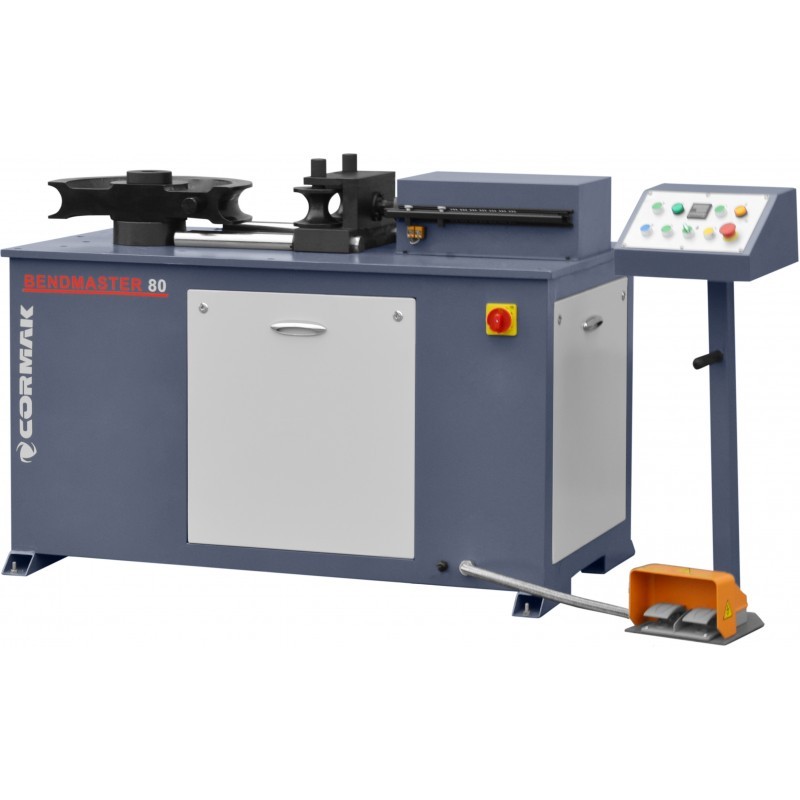
A pipe and profile bending machine enables the shaping of steel, aluminium, copper and stainless steel components without the need for cutting or welding. It is used in the manufacture of balustrades, steel structures, frames, installations, metal furniture, handrails, fences and decorative elements. A well-chosen machine helps to reduce the time taken to prepare components, minimise the number of joints and ensure a consistent shape for the finished part.
A pipe and profile bender enables the shaping of steel, aluminium, copper and stainless steel components without the need for cutting or welding. It is used in the production of balustrades, steel structures, frames, installations, metal furniture, handrails, fences and decorative elements. A well-chosen machine helps to reduce component preparation time, minimise the number of joints and ensure a consistent shape for the finished part.
The choice of machine should be based on the type of material, its dimensions, the required bending radius and the frequency of use. A workshop producing individual bends from thin tubing requires a different solution to a factory mass-producing components from hollow sections. Before purchasing, it is therefore worth determining not only the maximum dimensions of the material, but also the typical tasks carried out on a daily basis.
Pipe or profile – which will be bent most frequently?
The first step is to determine the cross-section of the material to be processed. Round tubes, square sections, rectangular sections, angle sections, channel sections and flat bars behave differently during bending. Each of these materials requires appropriately selected rollers, dies, bending stones or guides.
With round tubes, flattening of the cross-section and the formation of folds on the inside of the bend can be a problem. Closed sections, on the other hand, are prone to twisting, wall collapse and loss of corner geometry. The thinner the wall and the smaller the bending radius, the more important the quality of the tooling and the correct machine setup become.
Before purchasing, check the maximum pipe diameter or profile dimensions supported by the specific bending machine. Wall thickness is also important. Two components with the same external diameter may require completely different bending forces if they differ in material, thickness and steel grade.
Mandrel or mandrel-less bender?
A mandrel-less bender is a simpler solution for producing bends with a larger radius. It works well with relatively thick-walled pipes and in applications where slight deformation of the cross-section is acceptable. Machines of this type are used in metalworking workshops, by plumbing and heating contractors, and in the manufacture of simpler structures.
The mandrel-type model uses an element placed inside the pipe during bending. The mandrel supports the tube walls and minimises flattening, wrinkling and collapse of the cross-section. This solution is used for thin-walled tubes, small radii and components requiring a high-quality surface finish.
A mandrel bender is the better choice for the production of exhaust systems, handrails, pipework, stainless steel components and precision structures. However, it is more complex, requiring precise adjustment and the correct tooling for a specific diameter and wall thickness.
Roller bender for bends and large radii
Three-roller benders are primarily designed for bending tubes and profiles to a large radius. The material passes between the rollers, and its curvature increases gradually with each pass. This makes it possible to produce arcs, hoops, rings and decorative elements without creating a sharp bend at a single point.
Such machines are ideal for producing components for gates, canopies, balustrades, garden structures, frames and steel structures. They allow you to work with tubes, hollow sections, C-channels, angle sections and flat bars, provided the correct rollers are used.
However, a roller bender is not the best choice for making a single, tight bend at a specific point. In such cases, a die-type, hydraulic or mandrel-type model is more suitable, as it allows for more precise control over the bending point and the final angle.
Manual, hydraulic or electric drive?
A manual bending machine will be suitable for occasional work with small cross-sections. Its advantages include a simple design, low cost and no need for a power supply. However, when dealing with a larger number of components, manual operation can be slow and tiring, and consistency depends largely on the operator’s experience.
A hydraulic drive increases bending force and facilitates the processing of thicker materials. Such machines are well suited to metalworking workshops, service centres, assembly firms and small manufacturing plants. The hydraulic system allows work to be carried out with heavier loads whilst requiring less effort from the operator.
Electric and electromechanical bending machines are designed for more intensive use. They offer faster cycles, greater repeatability and easier control of parameters. In mass production, it is worth considering a model with programmable bending angles, stops, digital control and the ability to save settings for repeatable parts.
Bending radius and quality of the finished component
The minimum bending radius depends on the material, the pipe diameter, the wall thickness and the technology used. Attempting to bend too tightly can lead to the component cracking, flattening or buckling. This applies in particular to thin-walled tubes and profiles, which easily lose their corner geometry.
It is advisable to carry out a test bend before starting production. The material may spring back slightly once the pressure is released, so the final angle may differ from the set value. This springback phenomenon requires an adjustment to the parameters and should be taken into account during mass production.
The condition of the tooling is of great importance. Rollers and dies should be matched to the cross-section of the material. If the guidance is too loose, the risk of deformation increases, whilst an unsuitable tool surface may leave marks on the tube or profile. For decorative and stainless steel components, the surface quality of the tools is particularly important.
How to choose the right model?
Before purchasing a pipe and profile bender, you should determine several basic parameters. This will help you avoid choosing a machine that is too weak, too slow or unsuitable for your actual tasks.
- the type and cross-section of the material most frequently processed,
- the maximum pipe diameter or profile dimension,
- wall thickness and material grade,
- the required minimum bending radius,
- the length of the workpieces,
- the number of bends carried out per day,
- required angle repeatability,
- available rollers, dies and tooling.
For one-off jobs, a manual bender or a simple hydraulic bender is often sufficient. For the production of bends from profiles, a roller model is a good choice. For thin-walled tubes and tight radii, a mandrel bender is recommended. Mass production, on the other hand, requires an electric drive, a stable structure and the ability to set parameters precisely.
The most common mistakes when choosing a pipe bender
A common mistake is selecting a machine based solely on the maximum pipe diameter. In practice, wall thickness, material type and the required bend radius are equally important. A bending machine capable of handling a steel pipe of a specific diameter will not always produce the same result with a stainless steel or aluminium profile.
A second mistake is overlooking the tooling. Without the appropriate rollers, dies and guides, even a powerful machine may fail to achieve the required quality. It is also worth considering the workspace, the ability to feed long components, and the operator’s safety during the bending process.
Summary
The choice of a pipe and profile bender should be based on the actual tasks carried out in the workshop. The most important factors are the material cross-section, wall thickness, bending radius, forming technology and operating frequency.
A well-chosen machine minimises pipe flattening, profile twisting and the number of rejected components. It also makes it easier to achieve a consistent bend angle and allows for increased production efficiency without time-consuming cutting and welding of parts. CORMAK’s range includes pipe benders suitable for workshop, metalworking and manufacturing applications.
