


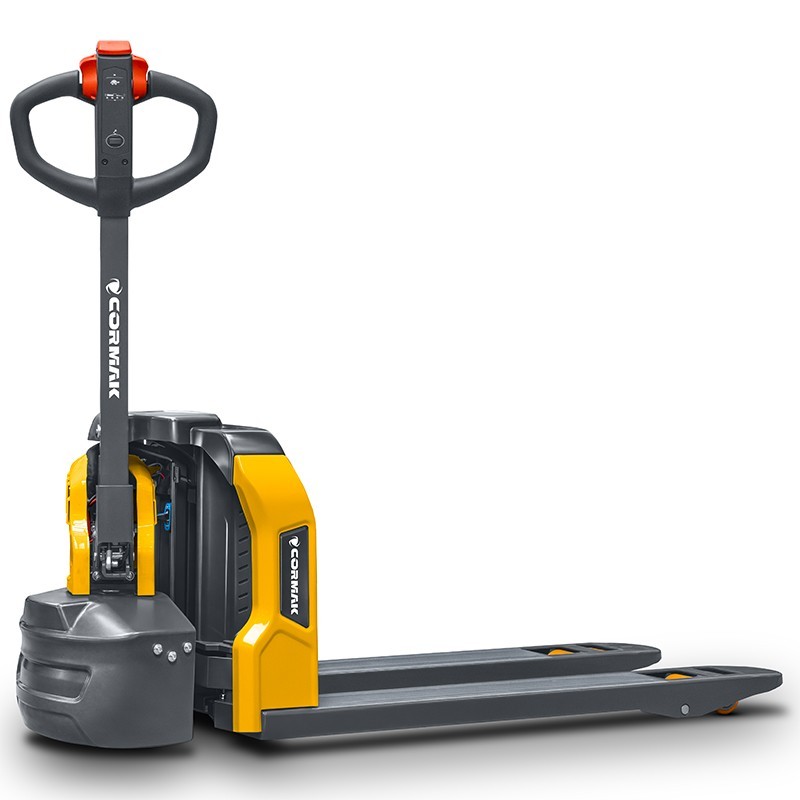
Choosing the right warehouse equipment affects the pace of work, the costs of handling goods and the safety of operators. Pallet trucks and mast trucks are both used to transport pallets, but they are not designed for the same tasks. An electric pallet truck is best suited to moving loads quickly across the floor, whilst a mast truck is required when a pallet needs to be lifted and placed on a rack.
Choosing the right warehouse equipment affects the pace of work, the costs of handling goods and the safety of operators. Pallet trucks and reach trucks are both used to transport pallets, but they are not designed for the same tasks. An electric pallet truck is best suited to moving loads quickly across the floor, whilst a reach truck is required when a pallet needs to be lifted and placed onto a rack.
The choice should not depend solely on the price of the equipment. Before purchasing, it is worth analysing the height of the warehouse, the weight of the heaviest pallets, the width of the aisles, the number of cycles per day, the type of flooring, and how goods are received and dispatched. Only such a comparison will reveal whether a pallet truck or a mast lift truck is the better choice.
Electric pallet truck – fast transport within the warehouse
An electric pallet truck is primarily designed for horizontal transport. It enables the convenient movement of loads between the goods-in area, production, the warehouse, order picking and dispatch. It works best where pallets are stored on the floor, on a ramp, at workstations or in a buffer zone.
Compared to a manual pallet truck, the electric model reduces the effort required by the operator. This is particularly important when regularly handling heavy pallets, covering longer transport distances and making a large number of repetitive journeys during a shift. Thanks to the electric drive, the operator does not have to pull or push the load manually, which improves ergonomics and can speed up day-to-day work.
An electric pallet truck is a good choice when:
- pallets are mainly transported on level, hard surfaces,
- there is no need to place goods on high racks,
- rapid horizontal transport is the priority,
- the warehouse has limited manoeuvring space,
- the company handles repetitive deliveries, order picking and dispatches,
- the operator moves many heavy pallets every day.
A standard pallet truck raises its forks just enough to lift a pallet off the floor and allow for transport. It cannot, therefore, replace a high-storage truck. If multi-level racking is used in the warehouse, a mast truck will be required.
Mast-type forklift – for use with racking
A mast-type forklift is designed to lift pallets to greater heights. It is the right choice for companies that store goods on racking and wish to make better use of the warehouse’s volume. It allows pallets to be placed on successive levels and loads to be removed from the racking.
The most important parameter is the lifting height. However, it is important to bear in mind that as the height increases, the actual load capacity of the truck changes. The forklift may be capable of handling a specific weight at lower lifting heights, but at the maximum height, the permissible load may be lower. Therefore, equipment should not be selected solely on the basis of the value stated in the model name.
A mast-type forklift is suitable when:
- the warehouse uses multi-level racking,
- high-level pallet storage is required,
- goods need to be regularly placed on or removed from the racks,
- the company wishes to increase warehouse capacity without extending the building,
- heavier or larger load units are handled,
- stacking height is more important than the speed of horizontal transport itself.
In small warehouses, a manual mast truck may also be a suitable option. It will be suitable for occasional lifting of lighter pallets or low-intensity work. For frequent storage, a higher number of cycles and heavier loads, an electric model will be the better solution.
Horizontal transport or high-bay storage?
The simplest distinction is as follows: a pallet truck is mainly used for transporting pallets, whilst a mast truck is used for lifting them. If most of the work involves moving goods from a lorry to the warehouse, from the warehouse to production, or from the order-picking area to dispatch, an electric pallet truck will be very practical.
However, if the pallets are to be placed on racks, you need to take into account the lifting height, load capacity at a given height and load stability. In such cases, a pallet truck will not be sufficient, as it is not designed for rack handling.
In many warehouses, the two types of equipment complement one another. A mast-type forklift handles racking and storage areas, whilst an electric pallet truck is responsible for rapid horizontal transport over longer distances. This division streamlines the flow of goods and reduces the unnecessary use of a single piece of equipment for all tasks.
How do you choose a truck to suit the working conditions?
Before purchasing, you should check the weight of the heaviest pallet, the maximum storage height and the width of the aisles. A mast truck requires more manoeuvring space than a standard pallet truck, so aisles that are too narrow may hinder operations or necessitate the selection of a more compact model.
The floor surface is also important. Electric-powered forklifts work best on level, hard-surfaced areas. Thresholds, slopes, uneven surfaces, drainage grates and changes in level must be taken into account when selecting the wheels, ground clearance and type of drive.
The number of cycles per day is also a factor. For occasional pallet transport or lifting, you can opt for simpler equipment. For multi-shift operation, a high number of trips and regular loading, it is worth choosing an electric truck with sufficient battery capacity, user-friendly controls and a robust design.
Key parameters to consider when choosing
When comparing pallet trucks and mast trucks, it is worth paying attention to more than just the load capacity. Equally important are the fork dimensions, turning radius, lift height, the machine’s unladen weight, the type of power supply and operational ergonomics.
- Lifting capacity – this should be matched to the heaviest loads, allowing for a margin of safety.
- Lifting height – crucial for racking and multi-level storage.
- Aisle width – affects manoeuvrability within the warehouse.
- Fork length – should be suitable for the pallets and load carriers used.
- Floor type – is important for the wheels, stability and driving comfort.
- Work intensity – determines whether an electric drive is the right choice.
Common mistakes when purchasing
A common mistake is choosing a pallet truck when there is a need to place loads onto racks in the warehouse. A pallet truck is fast and manoeuvrable, but it will not solve the problem of high-bay storage.
A second mistake is choosing a mast-type forklift without checking the aisle widths and working height. The machine may have the correct lifting capacity, but if it cannot manoeuvre freely within the warehouse, work will become slower and less safe.
It is also worth avoiding selecting equipment that is ‘just about adequate’. A margin in lifting capacity, the correct lift height and a well-chosen battery allow for safer handling of varying orders and future warehouse expansion.
Summary
An electric pallet truck is best suited for the day-to-day transport of pallets within a warehouse, particularly over longer distances and for repetitive journeys. A mast truck is the better choice when it is necessary to lift, place and remove goods from racking.
A good choice should take into account the load capacity, lifting height, aisle width, type of flooring, workload and actual goods throughput. This ensures that the equipment will not only speed up pallet handling but also improve workplace safety and minimise the risk of damage to loads.
