


Sandblasting is an effective method for cleaning metal and removing rust, paint, scale, deposits and old coatings. It is used in workshops, metalworking shops, car repair garages, and in the manufacture and restoration of parts. Before purchasing a machine, the question often arises: is a cabinet-type sandblaster or a siphon-type sandblaster the better choice?
Sandblasting is an effective method for cleaning metal and removing rust, paint, scale, deposits and old coatings. It is used in workshops, metalworking shops, car repair garages, and in the manufacture and refurbishment of parts. Before purchasing a machine, the question often arises: is a cabinet sandblaster or a siphon sandblaster the better choice?
Both solutions have different applications. A cabinet sandblaster is suitable for small and medium-sized components that can be placed inside the working chamber. A siphon sandblaster is more practical for larger parts, structural components and work carried out outside the cabinet.
The choice should depend on the size of the parts being cleaned, the type of contamination, the available space, the compressor’s capacity and the intensity of use.
Enclosed sandblasting cabinet – clean operation in a sealed chamber
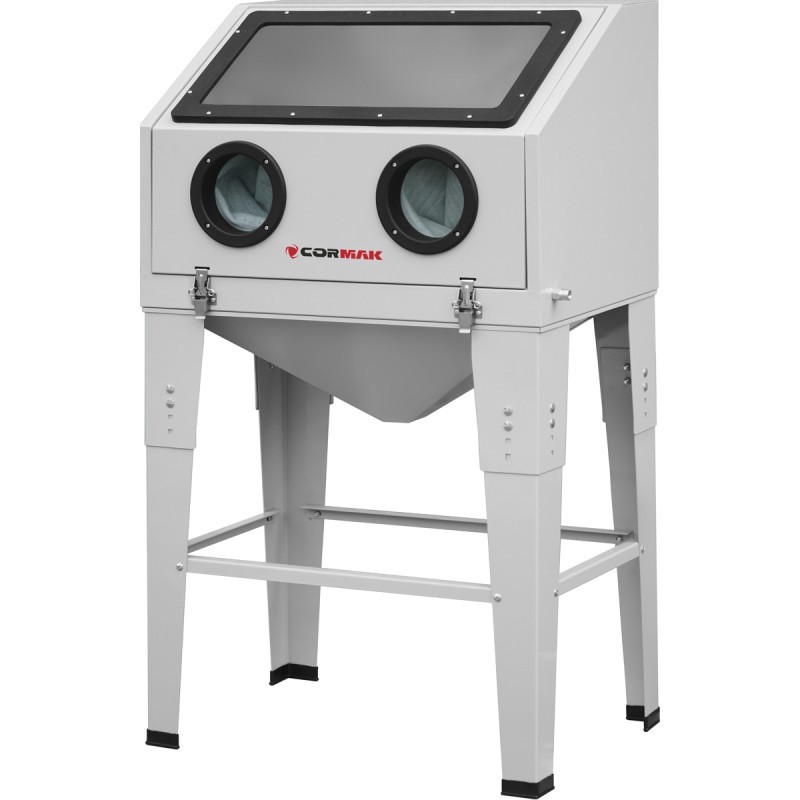
A cabinet-type sandblasting machine is a device with an enclosed working chamber. The operator places the part inside, closes the lid and carries out the blasting through gloves fitted inside the chamber. The abrasive remains inside the machine, making the workstation cleaner and easier to control.
This solution is very convenient for the regular cleaning of machine parts, wheel rims, tools, car components, handles, hinges, bodies, casings and small metal parts. An enclosed sandblasting unit allows work to be carried out in a more organised environment than open sandblasting.
A major advantage is the ability to reuse the abrasive material. The abrasive circulates within the working cycle, and the operator uses it up gradually. In practice, this reduces running costs, particularly when frequently sandblasting similar components.
The enclosed design also reduces dust levels in the workshop. Good dust extraction, efficient filtration and proper ventilation are still required, but the process is much more contained than with open-air blasting.
When should you choose an enclosed sandblasting machine?
An enclosed sandblasting machine is a good choice when the workpieces fit inside the working chamber. It is ideal for workshops that regularly clean parts with consistent dimensions.
It is worth choosing one if you value tidiness, process control and more economical use of abrasive. It is a good solution for companies that prepare parts for painting, refurbishment, technical inspection or further processing.
One limitation is the size of the chamber. If a part is too large, too heavy or has an unusual shape, it cannot be conveniently placed inside the chamber. In such cases, a different solution will be required.
Siphon-type sandblaster – greater freedom of operation
A siphon-type sandblaster works by drawing abrasive from a hopper and feeding it out together with a jet of compressed air. It can be used outside an enclosed cabinet, thus offering greater freedom when cleaning large components.
It is ideal for steel structures, frames, profiles, fences, larger machine parts, agricultural components, trailers, vehicle bodies and surfaces that cannot be placed inside a cabinet. It is more mobile and practical when working over a larger area.
A siphon-type sandblaster can be a good choice for companies carrying out restoration, structural cleaning or maintenance work. It allows you to focus on detail without being restricted by the size of the working chamber.
However, it is important to bear in mind that open-air operation generates more dust and requires better protection of the work area. Operator protection, suitable clothing, a respirator, air filtration and control of abrasive spread are essential.
When is a siphon-type sandblaster a better choice?
A siphon-type sandblasting machine is the better choice when the components to be cleaned are large, heavy or permanently fixed in place. It is ideal where a cabinet-type sandblasting machine is simply too small.
It is worth considering for the refurbishment of structures, the cleaning of steel sections, vehicle components, frames, machinery and industrial parts. This solution is ideal for users who require mobility and the ability to work with components of various sizes.
The downside is that it creates more mess and involves stricter safety requirements. The abrasive cannot always be easily recovered after use, and the workstation must be properly prepared.
The importance of the compressor and abrasive
Regardless of the type of equipment, the effectiveness of sandblasting depends on the compressor’s capacity. A compressor that is too small will cause pressure drops, poor performance and uneven operation. During prolonged sandblasting, it is not only the maximum pressure level that is important, but above all a consistent air flow rate.
You also need to choose the right abrasive. Different materials are suitable for removing rust from steel, for the gentler matt finishing of aluminium, and for cleaning components prior to painting. An abrasive that is too aggressive may damage the surface, whilst one that is too gentle will prolong the working time.
The moisture content in the compressed air is also important. Damp air can cause the abrasive to clump together and block the system. That is why it is advisable to use a dehumidifier and compressed air filters when sandblasting.
What should you choose for your workshop?
For the day-to-day cleaning of smaller parts, a cabinet sandblaster is the best choice. It keeps the area tidier, allows you to recover the abrasive and works well for repetitive tasks.
For larger components, a siphon-type sandblasting machine is a better choice. It offers greater flexibility and allows you to clean parts that cannot be enclosed within a cabinet.
In many workshops, a good solution is to combine both machines. The cabinet-type sandblaster handles small parts and regular workshop jobs, whilst the siphon-type is used for large structures and non-standard work.
Summary
An enclosed sandblasting machine is best suited to clean, controlled work on smaller components. It is ideal for workshops, service centres and factories that regularly clean metal parts.
A siphon-type sandblaster offers greater flexibility when working with large components and outside the cabinet. However, it requires better protection of the workstation and greater dust control.
When making your choice, it is worth considering the size of the components, the type of contamination, the available compressor, the abrasive and the working conditions. A well-chosen sandblaster will speed up cleaning, improve surface preparation and facilitate subsequent painting, welding or refurbishment of parts.
