


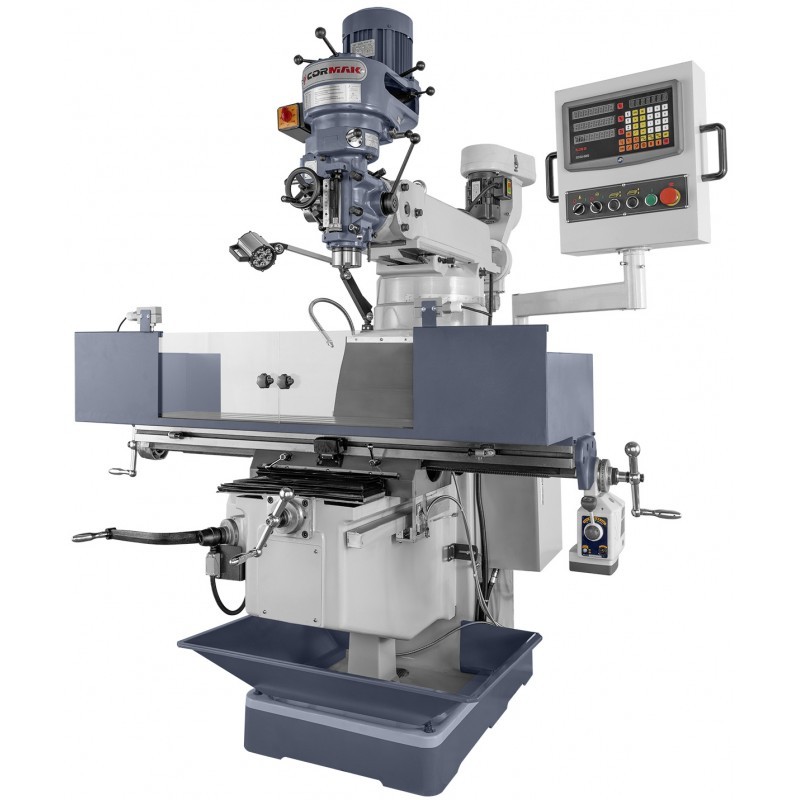
A metal milling machine is one of the essential machines in a metalworking workshop, tool room and production facility. It enables the production of flat surfaces, grooves, chamfers, holes, sockets, slots and technical components with repeatable dimensions. A well-chosen machine speeds up machining, improves surface quality and reduces the number of reworks required once the job is complete.
A metal milling machine is one of the essential machines in a metalworking workshop, tool room and production facility. It enables the creation of flat surfaces, grooves, chamfers, holes, sockets, slots and technical components with repeatable dimensions. A well-chosen machine speeds up machining, improves surface quality and reduces the number of reworks once the job is complete.
The choice of a milling machine should not be based solely on price. The most important factors are: the type of machine, working range, structural rigidity, motor power, spindle type, axis travel, feed rate, weight, power supply and the availability of accessories. It is worth determining straight away which materials will be machined most frequently and what level of accuracy the workshop requires.
What is a metal milling machine used for?
A milling machine performs mechanical machining by cutting. The tool, i.e. the milling cutter, rotates at a specific speed, whilst the workpiece is fed past the tool. This enables the controlled removal of material from the surface of the workpiece.
Milling differs from turning. On a lathe, it is usually the workpiece that rotates, whilst the material is removed by the turning tool. On a milling machine, the tool rotates, which offers great possibilities for creating flat surfaces, grooves, pockets and more complex shapes.
A metal milling machine is ideal for the production of:
- machine parts and assembly components;
- moulds, holders and workshop tools;
- grooves, splines, sockets and reference surfaces;
- prototypes and short runs;
- components requiring repeatable geometry.
What type of milling machine should you choose?
The first step is to match the type of machine to the planned machining operation. A different milling machine will be suitable for a small workshop than for a toolroom or mass production.
Vertical milling machine
A vertical milling machine is a versatile choice for many workshop tasks. It is well suited to machining flat surfaces, drilling, making holes and grooves, and working on smaller parts. It is easy to operate and is often chosen for metalworking shops, service centres and maintenance departments.
Horizontal milling machine
A horizontal milling machine is designed for heavier-duty work and longer workpieces. It can be advantageous for machining larger surfaces, deeper grooves and tasks requiring the stable removal of larger amounts of material.
Universal milling machine
A universal milling machine offers greater flexibility when a company carries out a variety of tasks. It can be a good choice for workshops that machine varied workpieces, produce prototypes or require a machine capable of performing multiple operations.
Bench-top or industrial milling machine?
For light work and small workpieces, a smaller bench-top milling machine will suffice. For day-to-day machining of steel, larger components and longer passes, it is better to choose a heavier, more rigid machine with a larger table and a stable column.
Key technical specifications
When choosing a milling machine, it is worth starting with the specifications that directly affect the scope of work and ease of use.
- work table size – determines the maximum dimensions of the workpiece to be clamped;
- X, Y and Z-axis travel – determines the area that can be machined without repositioning the workpiece;
- maximum table load – important for heavy workpieces and machine vices;
- spindle-to-table distance – affects the ability to work with tall workpieces and tooling;
- spindle speed range – should be suitable for the material, cutter diameter and type of machining;
- motor power – is important for cutting depth, milling width and harder materials.
Motor power alone is not enough. If the machine lacks sufficient rigidity, even a powerful motor will not ensure a good surface finish. Therefore, these parameters must be assessed together.
Rigidity, mass and operational stability
The rigidity of the structure is one of the most important criteria when selecting a metal milling machine. A stable body, a sturdy column, good guides and adequate weight help to minimise vibrations. This directly affects surface quality, dimensional accuracy and tool life.
When machining steel, a milling machine that is too light may start to vibrate, particularly with a longer tool overhang or a wider milling cutter. This results in surface marks, a poorer edge finish and a greater risk of the cutting edge chipping.
A heavier machine usually dampens vibrations better and operates more stably during deeper cutting. However, you must take into account the installation location, the floor’s load-bearing capacity, access for transport, unloading methods and the service space around the machine.
Spindle, feed rate and accessories
The spindle determines the stability of the router’s operation. Before purchasing, it is worth checking the taper type, speed range, runout, adjustability and availability of collet chucks. The popularity of a particular standard is important, as it affects the ease of sourcing accessories.
On simpler milling machines, the operator moves the table manually. For regular work, an automatic feed is a great help. It ensures a smoother cut, improves surface quality and reduces operator fatigue during longer operations.
It is worth planning to purchase accessories such as:
- a machine vice;
- collets and clamping sleeves;
- a set of cutters for the most common tasks;
- a rotary table or dividing head, if more complex operations are planned;
- a digital position readout, where dimensional repeatability is important;
- a cooling system for regular steel machining and longer cycles.
Power supply and machine set-up requirements
230 V models are suitable for lighter work, small workshops and maintenance applications. 400 V milling machines are better suited to regular professional use, larger workpieces and more demanding machining operations.
Before purchasing, you must check not only the available power supply but also the location where the machine will be set up. The following factors are important: a stable floor, the ability to level the machine, access to the worktable, space for long workpieces, lighting, chip removal and access to coolant.
The most common mistakes when buying a milling machine
- Choosing a machine that is too small – whilst it may suffice initially, it will quickly limit your ability to work on larger workpieces.
- Focusing solely on motor power – without a rigid structure, power alone will not translate into precise machining.
- Ignoring axis travel – too small a working range forces you to reposition the workpiece frequently.
- Lack of automatic feed – for longer passes, this makes it difficult to achieve a smooth surface.
- Inappropriate power supply – the machine should be suited to the workshop’s technical conditions.
- Lack of accessories – even a good milling machine will not be able to realise its full potential without the appropriate vice, tool holders and tools.
Quick comparison of selection criteria
| Criterion | Why is it important? | What to look out for? |
|---|---|---|
| Work table | Determines the size of the workpiece to be clamped | Dimensions, T-slots, maximum load |
| Axial travel | Determine the machining range without repositioning the workpiece | X, Y, Z travel ranges and ease of adjustment |
| Rigidity | Reduces vibration and improves surface finish | Mass, column, guideways, machine body stability |
| Spindle | Determines the stability of the tool’s operation | Taper type, speed range, availability of tool holders |
| Feed | Affects the smoothness of machining and the operator’s comfort | Manual or automatic, adjustment range |
| Power supply | Must be suitable for workshop conditions | 230 V for lighter work, 400 V for regular professional use |
Milling versus other machining processes
Milling is a form of machining. It should not be confused with plastic deformation, heat treatment or thermochemical treatment. These processes alter the shape or properties of the material in a different way. A milling machine removes material using a cutting tool, thereby allowing precise control over the dimensions and geometry of the workpiece.
Summary
The choice of a metal milling machine should be based on the workshop’s actual needs. A smaller bench-top machine is sufficient for simple jobs. For day-to-day work, machining steel and larger workpieces, a heavier milling machine with a powerful motor, a stable structure, an appropriate range of travel and automatic feed will be more suitable.
A well-chosen milling machine increases accuracy, reduces working time and facilitates metal machining in a professional workshop. Before purchasing, it is worth analysing not only the price, but also the rigidity, spindle, table, accessories, power supply and future production needs.
