


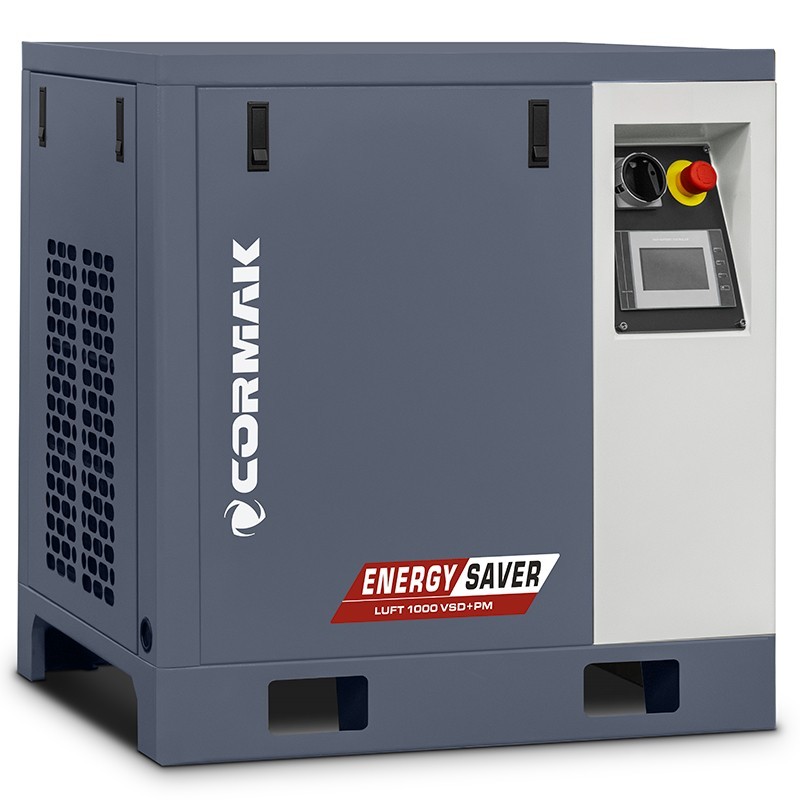
A PM motor in a screw compressor is the solution of choice for companies seeking to reduce energy costs, improve pressure stability and better tailor the compressor’s operation to actual compressed air demand. In production facilities, service centres, paint shops and workshops, compressors often run for many hours every day, which is why the purchase price should not be the sole criterion for selection.
A PM motor in a screw compressor is a solution chosen by companies wishing to reduce energy costs, improve pressure stability and better match the compressor’s operation to the actual demand for compressed air. In manufacturing plants, service centres, paint shops and workshops, compressors often run for many hours every day, so the purchase price should not be the sole criterion for selection.
The most important factor is the total cost of ownership. This includes electricity, servicing, the unit’s efficiency, noise levels, operational stability and the reliability of the entire system. It is precisely in this area that a compressor with a PM motor can deliver the greatest benefits.
What is a PM motor in a compressor?
A PM motor, or permanent magnet motor, uses permanent magnets to generate a magnetic field in the rotor. In practice, this means lower energy losses than in many conventional drive systems, as well as high efficiency across a wide range of loads.
In screw compressors, the PM motor usually works in conjunction with an inverter. The inverter regulates the motor’s rotational speed, whilst the compressor adjusts its output to match the current air demand. If the system requires less air, the unit reduces its speed. When demand increases, the compressor boosts its output.
This is particularly important because, in many plants, compressed air consumption is not constant. Demand varies depending on the number of workstations, the machines in operation, the production cycle and the operators’ current tasks.
Why is energy the biggest cost?
The purchase price of a compressor is a one-off expense. Electricity is a fixed cost that arises every day the unit is in operation. The longer a screw compressor runs, the more important its efficiency becomes.
In many companies, energy can account for the largest proportion of the operating costs of a compressed air system. This is particularly true of facilities where compressors supply production lines, assembly workstations, packaging systems, paint shops, service centres or numerous pneumatic tools simultaneously.
Therefore, when selecting a unit, it is worth analysing not only the motor power and purchase price, but also the number of operating hours per year, the air consumption profile, the required working pressure and the condition of the entire system.
How does a PM motor-driven compressor work?
A compressor with a PM motor operates more flexibly than a conventional unit running at a constant speed. The control system analyses the system’s demand and adjusts the motor speed to maintain the set pressure whilst ensuring the most efficient operation possible.
If air demand is low, the compressor does not need to run at full power. If production picks up and demand increases, the unit boosts its output. This allows it to minimise idling, reduce pressure fluctuations and cut down on unnecessary energy consumption.
The biggest difference is seen in plants where the load varies throughout the day. In the morning, individual workstations are in operation; during the middle of the shift, further machines are brought online; and towards the end of the day, air demand falls again. Under such conditions, a variable-speed PM compressor can better adapt to actual production needs.
Key advantages of a screw compressor with a PM motor
Lower operating costs
The most significant benefit is the ability to reduce energy consumption, particularly where the demand for compressed air fluctuates. The compressor does not run at full power all the time, but adjusts its speed to the current load.
Stable operating pressure
The PM compressor can respond more precisely to changes in air demand. Stable pressure is important for pneumatic tools, production machinery, feeding systems, blow-off systems and painting systems.
Quiet and smooth operation
Smooth speed control reduces sudden starts and can improve the unit’s running characteristics. This is important in workshops and factories where the compressor operates close to workstations.
Better adaptation to the system
A PM motor, when combined with an inverter, enables more efficient operation of systems with variable air demand. This makes the unit more predictable in day-to-day operation.
Where is a screw compressor with a PM motor best suited?
Screw compressors with a PM motor are suitable wherever compressed air is used regularly and for many hours at a time. They are ideal for use in, amongst other places:
- manufacturing plants;
- car and mechanical workshops;
- paint shops;
- technical service centres;
- metal and woodworking companies;
- warehouses and packing lines;
- maintenance departments.
In a workshop, a compressor can power pneumatic wrenches, paint spray guns, grinders, blowers and inflation equipment. In manufacturing, it can supply machines operating continuously or multiple workstations simultaneously.
Is an oil-free compressor an alternative?
Oil-free compressors are chosen where a particularly high level of compressed air purity is required, for example in the food, pharmaceutical, electronics or medical sectors. However, this does not mean that they will always be the best choice for every facility.
In many industrial applications, the most important factors are: performance, stable pressure, energy costs, service availability and reliability. In such situations, a screw compressor with a PM motor can be a very advantageous solution. The choice should be based on air quality requirements and the actual operating conditions of the system.
How to select the right compressor?
The selection of a compressor should begin with an analysis of the system’s requirements. It is not advisable to choose a unit solely on the basis of motor power or list price. The entire compressed air system is important.
Before purchasing, you should determine:
- the required effective capacity;
- the working pressure required by the end-users;
- the number of workstations operating simultaneously;
- the number of operating hours per day and per year;
- air intake profile: constant or variable;
- permissible noise level in the workplace;
- maintenance and servicing requirements.
A compressor that is too small will constantly be operating under heavy load, which may lead to pressure problems and accelerated wear and tear. A compressor that is too large may result in unnecessary purchase and energy costs. The best choice is a unit tailored to the company’s actual requirements.
When is a PM motor most cost-effective?
A PM motor offers the greatest value when the compressor operates regularly, for many hours, and with fluctuating air demand. The longer the unit’s operating time, the greater the impact of drive efficiency and capacity control on costs.
The greatest benefits are seen in businesses where air demand fluctuates, rising and falling. A PM compressor helps to avoid situations where the unit operates at high power despite low system demand.
However, the extra cost of this technology will not always be justified. If the compressor operates sporadically, for short periods and under light loads, a conventional unit may be sufficient. Cost-effectiveness depends on operating hours, energy prices, the air consumption profile and the difference in purchase price.
How do you calculate the return on investment?
A basic calculation can be carried out in a few steps. First, estimate the annual energy cost:
Annual energy cost = compressor power × number of operating hours × price per 1 kWh
Next, you can estimate the annual savings:
Annual savings = annual energy cost × percentage saved
Finally, you can work out the approximate payback period:
Payback period = difference in purchase price / annual savings
Example: a 15 kW compressor operates for 2,080 hours a year, and the price of electricity is 1 zł/kWh. The annual energy cost is 31,200 zł. With a 20 per cent saving, this amounts to approximately 6,240 zł per year, and with a 30 per cent saving, approximately 9,360 zł per year. These are approximate figures which need to be adjusted to the actual operating conditions of the plant.
What else affects operating costs?
The PM motor is important, but it is not the only factor determining costs. The condition of the compressed air system is also of great importance.
- Leaks cause energy losses and force the compressor to run more frequently.
- Excessively high operating pressure increases energy consumption without providing any real benefit to the process.
- Incorrectly selected hoses and quick-connect couplings can cause pressure drops.
- A lack of regular servicing reduces the efficiency of the equipment and increases the risk of breakdowns.
- Worn filters, oil and separators affect performance and operational stability.
Even a highly energy-efficient compressor will not reach its full potential if the system is leaky, incorrectly configured or poorly maintained. Therefore, the best results are achieved through a combination of a well-functioning unit, correct selection and regular inspection of the entire system.
Summary
A PM motor in a screw compressor is particularly cost-effective when compressed air is used regularly and air demand fluctuates throughout the day. Thanks to the combination of a permanent magnet motor and inverter control, the compressor can better adapt its operation to the system’s current needs.
The main benefits include lower energy consumption, more stable operating pressure, quieter operation and greater cost predictability. However, for occasional use, a conventional compressor may suffice, so it is worth calculating the total cost of ownership before purchasing.
When choosing a screw compressor, it is worth looking beyond the purchase price alone. What matters is performance, pressure, operating hours, servicing, the condition of the installation, and the ability to tailor the unit’s operation to the facility’s actual requirements.
