


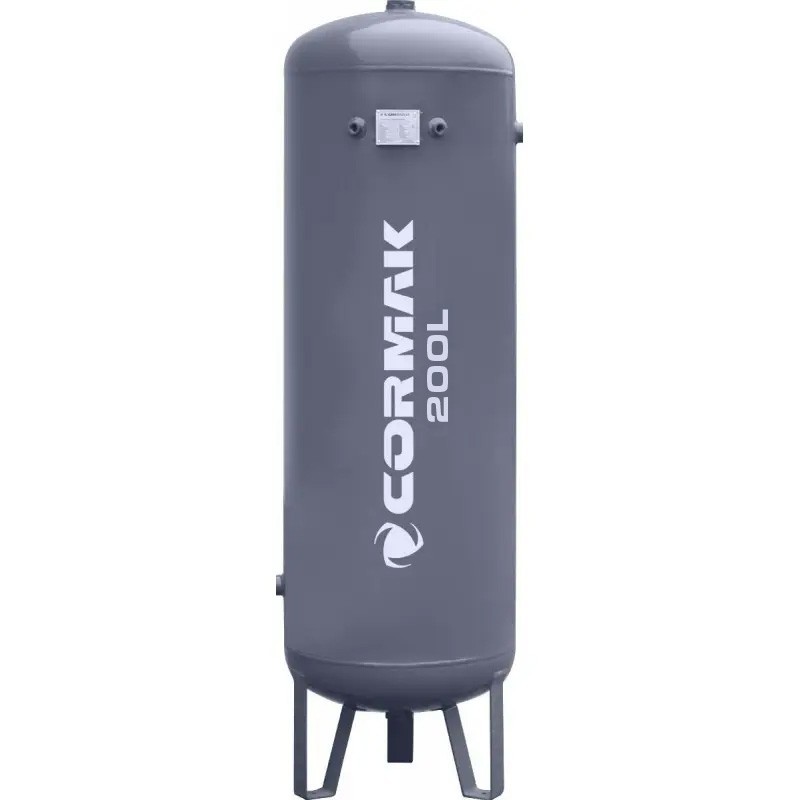
Expanding the compressed air system with an additional tank can increase the available air supply, reduce short-term pressure fluctuations and improve the performance of pneumatic tools. However, it does not increase the actual capacity of the compressor, i.e. the amount of air it can supply continuously.
Expanding your compressed air system with an additional tank can increase the available air supply, reduce short-term pressure fluctuations and make it easier to use pneumatic tools. However, it does not increase the compressor’s actual capacity, i.e. the amount of air it can continuously supply.
In this guide, we explain the benefits of an additional tank, how to select the right components and how to plan the extension safely. As compressed air tanks operate under pressure, the selection, installation and commissioning of the system should be entrusted to a competent contractor, in accordance with the manufacturer’s documentation and the requirements applicable at the site of operation.
What are the benefits of an additional compressor tank?
An additional tank acts as a compressed air reservoir. During temporary spikes in demand, consumers can draw on the air stored across the entire system capacity. This helps to minimise brief pressure drops, particularly when tools are operating in cycles.
- a larger supply of compressed air;
- more stable pressure during temporary demand peaks;
- less frequent compressor start-ups in systems with irregular demand;
- more time for condensate drainage and partial cooling of the air;
- better organisation of the air supply to tools used intermittently.
This solution can be useful when working with pneumatic wrenches, paint spray guns, assembly workstations or tyre inflation systems. However, the end result depends on the compressor’s capacity, the diameter of the hoses, the length of the system, the filtration and the actual air consumption profile.
What does an additional tank not solve?
A larger tank capacity does not increase the compressor’s effective output. If the tools consistently consume more air than the compressor can supply, an additional tank will merely delay the onset of a pressure drop.
In the event of a persistent shortage of compressed air, it is worth analysing the entire system: compressor capacity, working pressure, leaks, filtration quality, drying, pipe diameters and the nature of the air consumption. In practice, a compressor with a higher capacity or optimisation of the air consumers may be required.
How should a pressure tank be selected?
The selection should be based on an analysis of the installation carried out by a competent person. It is not only the capacity that matters, but also safety, operating conditions and the compatibility of the entire system.
Tank capacity
A larger capacity provides a greater air buffer, but also means greater weight, as well as increased space, drainage and maintenance requirements. The capacity should be tailored to the consumption profile, rather than solely to the compressor motor’s power.
Permissible pressure
The maximum permissible pressure of the tank, pipework and fittings must correspond to the designed operating parameters. The limits specified by the manufacturers of any component in the system must not be exceeded.
Documentation and compliance
Tanks, pipes and fittings designed for use with compressed air must be used in the installation. It is advisable to keep the documentation, rating data and operating instructions for the equipment. Depending on the parameters and method of use, the tank may be subject to technical inspection requirements or other local requirements.
Operating conditions
Consideration must be given to temperature, humidity, the risk of corrosion, ventilation, access for maintenance and a stable foundation. The tank should be protected against mechanical damage and impact from a forklift or vehicle.
Parallel or series configuration?
When expanding a system, a parallel connection is most commonly used, in which both tanks are supplied from a common main line. This facilitates the utilisation of the combined storage capacity and can reduce unnecessary flow resistance.
Parallel connection
- both tanks are connected to a common supply line;
- compressed air is available from the system’s total capacity;
- it is easier to isolate one tank during maintenance;
- pipe diameters and fittings are selected to match the required flow rate.
Series connection
A series configuration may cause additional resistance and hinder condensate drainage. It should only be used when specified in the technical design, rather than as a result of haphazard pipework routing.
How to plan the installation safely?
Expanding a pressurised system should not be treated as a simple ‘do-it-yourself’ task. Safe installation must be carried out by a qualified installer in accordance with the technical documentation and applicable requirements.
- Assessment of the existing system: verification of the parameters of the compressor, the existing receiver tank, the receivers and the pipework.
- Selection of components: checking the maximum permissible pressure, materials, diameters and compatibility of fittings.
- Site preparation: stable positioning of the tank, protection against impact and access for servicing.
- Fitting of fittings: installation of shut-off valves, drainage and safety devices in accordance with the design.
- Inspection and commissioning: checking for leaks, system operation and documentation in accordance with the manufacturers’ procedures.
Before commencing work, the system must be disconnected from the power supply, completely depressurised and secured against accidental start-up. Do not weld, drill or modify the tank, nor tamper with the safety valves.
System components
The exact configuration depends on the design, but a typical system may include:
- a pressure vessel suitable for the system;
- hoses or pipework of suitable cross-section and rated pressure;
- shut-off valves to isolate the tank;
- check valves, where required by the flow diagram;
- pressure gauges or pressure sensors suitable for the system;
- safety valves suitable for the tank’s specifications;
- a manual or automatic condensate drain;
- filters, separators and dehumidifiers selected to meet the required air quality.
Components should not be selected solely on the basis of thread diameter. Other factors that matter include the material, maximum pressure, temperature, flow rate and compatibility with the entire system.
The most common mistakes when expanding a pneumatic system
- Pipe cross-sections that are too small: this can increase pressure drops and restrict flow.
- Components with incompatible specifications: each component must be suitable for the pressure and operating conditions.
- Lack of effective condensate drainage: this increases the risk of corrosion and degrades air quality.
- Failure to check for leaks: leaks cause energy losses and reduce system efficiency.
- Treating the air receiver as a substitute for a small compressor: an air receiver cannot replace the required continuous capacity.
- Tampering with safety components: safety valves must not be blocked, accidentally adjusted or replaced with unsuitable parts.
Safety and operation
Compressed air tanks operate under pressure. They require regular condensate drainage, technical inspections and protection against corrosion and mechanical damage.
- Do not exceed the permissible pressure of any component;
- keep safety valves accessible and in good working order;
- check the tanks regularly for corrosion, damage and leaks;
- drain condensate in accordance with the equipment’s instructions;
- carry out the inspections and maintain the records required for the site of operation;
- Before servicing, switch off the power supply, release the pressure and secure the system against accidental restart.
An additional tank versus a larger compressor – a comparison
| Criterion | Additional tank | Higher-capacity compressor |
|---|---|---|
| Main function | Increases air storage capacity | Increases the capacity for continuous air supply |
| Best use | Short, variable consumption peaks | Constant or prolonged high demand |
| Impact on performance | Does not increase the effective capacity of the compressor | May increase available flow rate when correctly selected |
| Requirements | Safe design, appropriate fittings and commissioning | Selection based on consumption profile, installation and air quality |
Summary
An additional tank can increase the compressed air supply and improve stability during short-term fluctuations in consumption. However, it cannot replace a compressor with sufficient capacity when demand is consistently high.
The most important factors are: compatible equipment specifications, appropriate pipe diameters, effective condensate drainage, safety measures and installation carried out by a competent person. A well-designed system will operate more stably, safely and predictably.
